The Serbian government under Aleksandar Vučić appears to be preparing the police for a final confrontation with political dissenters, accelerating a process that insiders describe as the creation of a parallel, extra-institutional power structure known as “Ćacilend.” This stronghold, populated by loyalists and individuals from criminal networks, is now the center of operations for a deeply politicized security apparatus.
Recent appointments within the police demonstrate that professional criteria have been replaced entirely by loyalty tests. Those promoted are individuals known for their brutality toward students and citizens, as well as for their unwavering obedience to Vučić. What began in 2014 as an erosion of institutional independence is now culminating in the transformation of the police into an openly partisan enforcement arm.
Highly Controversial Police Appointments
According to internal sources, the new head of the Criminal Police Directorate (UKP)—the core of the Ministry of Interior—will be Marko Kričak, a minimally trained officer and former commander of the notorious JZO. He is reportedly bringing along a team of his closest associates.
Kričak and newly appointed Gendarmerie Commander Radoslav Repac share two traits: long-standing brutality and public praise from Vučić. Repac, unlike Kričak, has formal police education, but both are seen as enforcers rather than professionals.
Several other major shifts follow the same pattern:
- Saša Kosović, former Gendarmerie commander, is now assistant to Police Director Dragan Vasiljević.
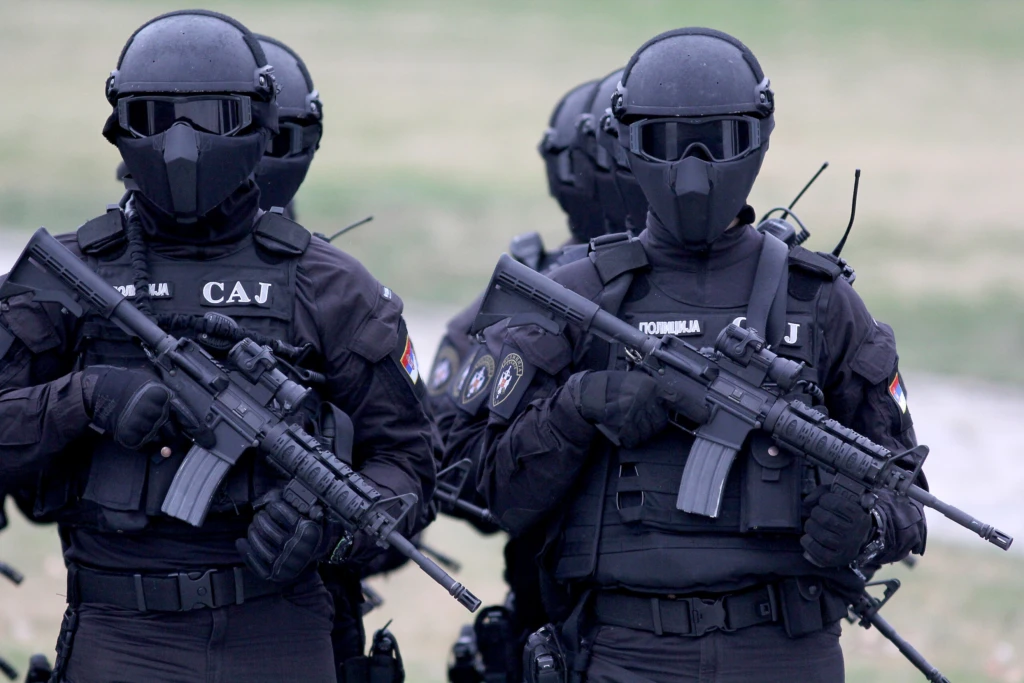
- The Special Anti-Terrorist Unit (SAJ) will now be led by Igor Žmirić, Kričak’s associate from JZO, also known for violence.
- Acting UKP chief Nemanja Đuran is under suspicion for filtering SKY ECC encrypted communications, allegedly deleting or concealing evidence implicating state and security officials.
Internal sources report that after recent purges, officers were instructed not to answer calls from the Organized Crime Prosecutor’s Office (TOK), especially following past investigations that led to arrests of ministers.
Manipulation of Voter Registries
The process dubbed “Kričak-ization of the police” is also affecting the Ministry’s IT Directorate, which manages voter databases.
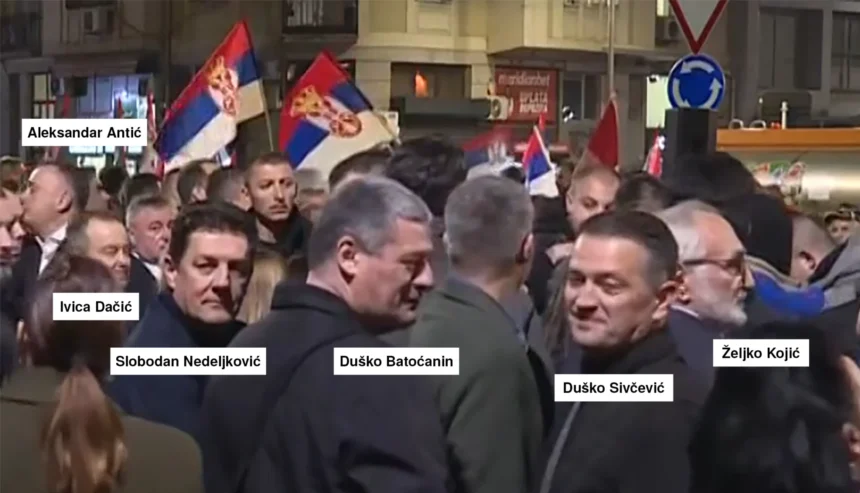
Key officials, including Duško Sivčević and Duško Batoćanin, are allegedly involved in the mass registration of new voters, including individuals from Bosnia and Kosovo, often assigned to non-existent addresses.
Questions remain about:
- Use of administrator-level access for data manipulation
- The replacement of server hard drives after every election
- Whether such access allows the removal of arrest warrants or registration of stolen vehicles
These concerns intensified when Sivčević, Batoćanin and other top IT officials were seen at a ruling party rally in Ćacilend on November 5—an event organized as a counter-protest to student gatherings.
Internal Controls Paralyzed
The Internal Control Service (SUK), led by Miroslav Paunović, is accused of intentionally delaying or burying countless investigations, including cases of excessive force and even the death of Dalibor Dragijević, who was beaten while in police custody.
This paralysis, according to officers, is a deliberate strategy to shield violent officers loyal to the ruling party.
Escalation of Police Brutality
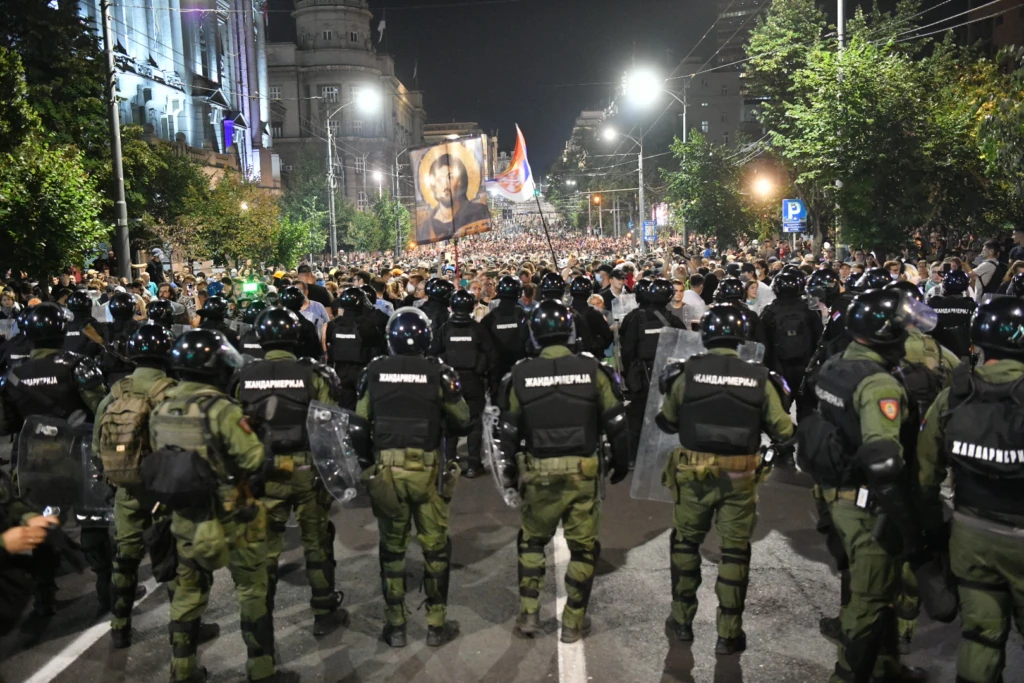
Police sources agree that April 28, 2025 was the turning point. Until then, officers had refrained from violence against protesters. But that day, during student gatherings at the Novi Sad Faculty of Sports, the Interventions Unit used extraordinary force, marking the start of a new phase of repression.
Since then:
- Unmarked, masked officers routinely attack students and citizens
- Individuals are chased, beaten, detained without identification
- Radio communications allegedly included directives like:
“Tonight: 100 detainees.”
Officers report that many interventions were triggered by staged attacks from masked groups resembling hooligans, often allowed to escape through police lines. These tactics were first used during protests in 2020 and repeated in 2023 and 2025.
Paramilitary Culture Inside Elite Units
Gendarmerie
Long considered problematic since its founding in 2001, the Gendarmerie remains influenced by wartime PTSD, paramilitary training methods, and a culture resembling criminal groups more than police units.
Commanders such as Mića Kljajić and Mirko Mijučić are cited for their extreme violence toward students.
Beograd Police Brigade
Once respected, the Brigade has become heavily politicized under Repac, now linked with Andrej Vučić. Its interventions across Belgrade included indiscriminate violence and tear gas deployment in residential areas.
JZO – The Personal Enforcement Unit
Under Marko Kričak, JZO has transformed from a protection unit into a tool for abductions, beatings and intimidation, often operating in civilian clothes and without authorization from police leadership.
Kričak is reportedly in direct communication with Aleksandar and Andrej Vučić, bypassing police command structures.
Intervention Units Across Serbia
Intervention units from Novi Sad, Valjevo, Priboj, Prijepolje and Užice have been identified as particularly brutal, especially during the Valjevo events on August 14–15. Students were beaten inside police stations, left kneeling for hours, and subjected to severe humiliation.
Sources say these officers were explicitly instructed to use overwhelming force.
Ćacilend: A Safe Haven for Criminal Groups
Multiple officers claim that since March, police units have been deployed to protect criminal groups inside Ćacilend, where gang members interact with high-ranking officers. Figures like Vlada Mandić allegedly control parts of the police presence.
This has created a climate of fear within the force, where dissent is seen as betrayal that could lead to retaliation.
A Militarized and Politicized Security Structure
Increased salaries, bonuses, and career incentives further strengthen loyalty to senior commanders. Officers describe a culture of:
- Rigid hierarchy
- Group deindividualization
- A “brotherhood until death” mentality
- Coercion and intimidation for dissenting views
Together, these practices have transformed the police into a Praetorian Guard—a force designed not to protect citizens, but to defend the ruling establishment at any cost.