“[Aleksandar] Vučić is preparing for his return to the position of Prime Minister.”
This is how Zoran Stojilković, a professor at the Faculty of Political Sciences in Belgrade, interprets the Serbian government session in which President Vučić reprimanded ministers and other state officials.
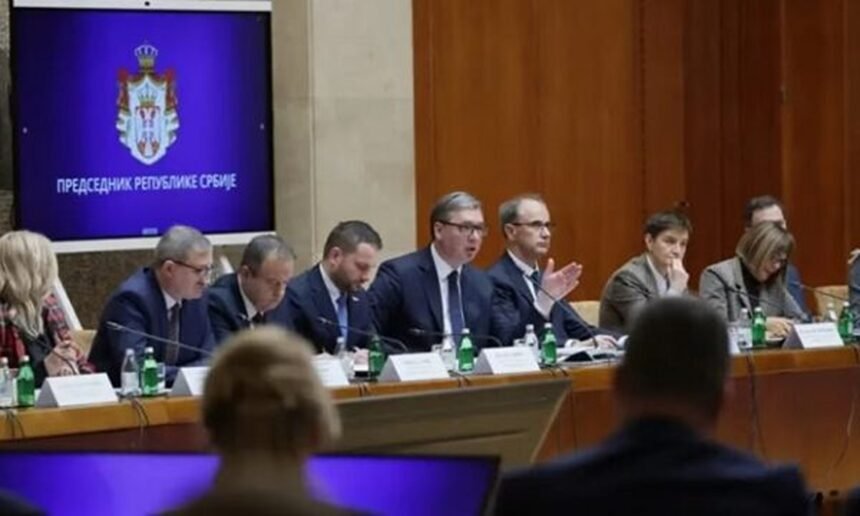
Amid warnings that Serbia could face early parliamentary elections by the end of the year, Vučić, at the invitation of Prime Minister Guro Macut, attended the government session held on January 25.
In a stern tone, he questioned ministers and directors of public enterprises, criticized their work ethics, indulgence in privileges and travel, and invited them to resign if they lacked “sufficient energy and willingness.”
Stojilković describes the session as an example of “the usual level of humiliation of closest associates,” intended to publicly show that nothing can function “without Vučić’s interventions.”
“The message repeated by his party members is that without him, there is no Serbian Progressive Party. Vučić already has two terms as president, and logically, it is expected that he will appear [as a candidate] for prime minister,” Stojilković told Radio Free Europe.
Vučić previously held this role before being elected President of Serbia in 2017.
This is his second presidential term, which ends next May. According to the Serbian Constitution, he is no longer eligible to run for president.
Vučić has not ruled out the possibility of running for prime minister in the upcoming elections.
“If we see that it is possible to win without me running, I certainly will not run. If I see it is not possible otherwise, I may make a different decision,” he said on December 28 to Serbia’s Pink TV.
When Could the Elections Take Place?
The announcement of early parliamentary elections is one of the main demands of the students who have been leading anti-government protests in Serbia for over a year.
They say it is the path to change and accountability for the deaths of 16 people in an accident at Novi Sad railway station in November 2024.
Although the government rejected this demand for months, Vučić stated at the end of last year that it would be fulfilled.
Publicly, he mentioned several possible dates for the next elections – perhaps in the spring, perhaps at the end of this year, or at the start of next year.
After the government session on January 25, he indicated it is “realistic” for elections to be held between October and December.
Stojilković expects 2026 to be an election year.
“I think this timeline, the end of the year, suits the government because presidential elections can also be announced then – which would further shake the opposition scene,” he said.
Stojilković also noted that the only opposition actor with significant public support at this moment is the student-led list.
Students Prepare for Elections
There is widespread public talk of a “student list” being prepared for the next parliamentary elections.
Academics emphasize that they themselves will not run but will decide who will be included on the list they support.
During a protest in Novi Sad on January 17, the academics also presented parts of their program.
“They focus on corruption, sources of wealth, and raise an issue long discussed but never acted upon in Serbia – namely lustration,” Stojilković recalls.
Since Vučić’s Serbian Progressive Party came to power in 2012, four early parliamentary elections have been held.
Regular parliamentary elections in Serbia occur every four years, with the last held in December 2023.
Possible Government Restructuring
Following the government session in which Vučić reprimanded ministers, Prime Minister Guro Macut informed citizens that a cabinet restructuring is being considered in the spring.
“I think the time has come to provide accountability based on your level of engagement,” he said in an interview with Radio-Television Serbia on January 27.
“The warning about restructuring aims to intimidate and discipline current government members, as well as create pseudo-political events and manipulations to divert citizens’ attention from serious state issues,” Stojilković assesses.
The current government, led by Macut, was elected by the Serbian Parliament in April last year.
His predecessor, Milosh Vučević, resigned under public pressure due to attacks by Serbian Progressive Party activists against a group of students in January 2025.
/REL/