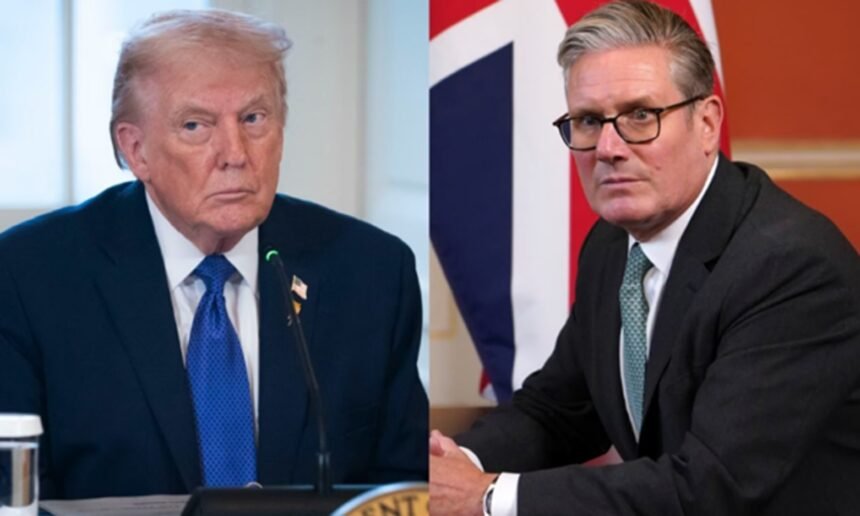
British Prime Minister Keir Starmer is “angry” with US President Donald Trump following the latter’s comments regarding NATO troops in Afghanistan. This assessment comes from Beth Rigby, Sky News’ political editor, in an analysis she has written.
Rigby notes that Starmer’s comments in response to the US president represent a clear shift in tone, as he personally criticised Trump strongly and suggested that the American president should apologise.
“By making such offensive comments—immediately after threats of sanctions and invasions against a NATO ally—the so-called special relationship is quickly taking the shape of a toxic relationship,” she writes in her analysis.
Analysis:
I’ve never seen Starmer this angry – and it could accelerate a turn toward Europe
I have rarely seen Keir Starmer angry. He is a politician who keeps his emotions under tight control—at least in public.
But he was clearly filled with anger when he criticised President Trump for his “offensive and frankly shameful” comments about non-American troops who served in Afghanistan.
Starmer had spent the night at Chequers after hosting his Danish counterpart for bilateral talks on Greenland and NATO, and returned to Downing Street this morning amid growing national anger over Trump’s shameful insult toward NATO troops.
In his strongest rebuke yet of Trump, the Prime Minister was highly critical of the president’s claim that NATO troops in Afghanistan “stayed well back from the front line.”
For context, 1,160 non-US coalition troops were killed in Afghanistan and thousands more were wounded, some with life-changing injuries.
In total, 457 British troops lost their lives fighting alongside American forces.
The fact that President Trump so casually downplayed these sacrifices has triggered an outpouring of anger and widespread condemnation.
This is an insult not only to our forces, but also to a relationship built on a shared language and extraordinarily close cultural, political, military, and economic ties over decades.
By making such offensive remarks—coming immediately after threats of sanctions and invasions against a NATO ally—the so-called special relationship is rapidly beginning to look like a toxic one.
For a Prime Minister whose primary duty is the security of his country and its citizens, the fact that another leader insults his armed forces is a low blow. I am told that Starmer wanted to make his position very clear and to speak out in defence of our armed forces.
A clear shift in tone
Until now, he had only condemned Trump’s comments or actions as wrong.
Today’s remarks represent a clear change in tone, as he personally criticised Trump strongly and suggested that the president should apologise.
As for the consequences, Downing Street’s approach will be to try to carry on as before—adhering to Britain’s principles and values and working with the US on defence, security, and intelligence.
But there is no doubt that the past week has shattered the illusion.
Trump’s increasingly erratic and bizarre behaviour has left Starmer with little choice but to move away from a policy of “containing Trump” and to criticise him openly.
Increasingly toxic
In other circumstances, a prime minister who had invested heavily in managing relations with Trump, only to see them deteriorate so badly, might have come under intense criticism.
What protects him is the widespread condemnation of President Trump from across the political spectrum.
Indeed, Starmer may now face even greater pressure to harden his stance toward an increasingly toxic partner: the United States.
The Prime Minister’s allies sought to stress that this is not the beginning of the end of the special relationship—but it is equally true that events over the past week have made that bond appear far less resilient.
Starmer was already seeking to deepen and strengthen ties with Europe. After the behaviour of Trump’s White House this week, he may now want to accelerate that process even further.