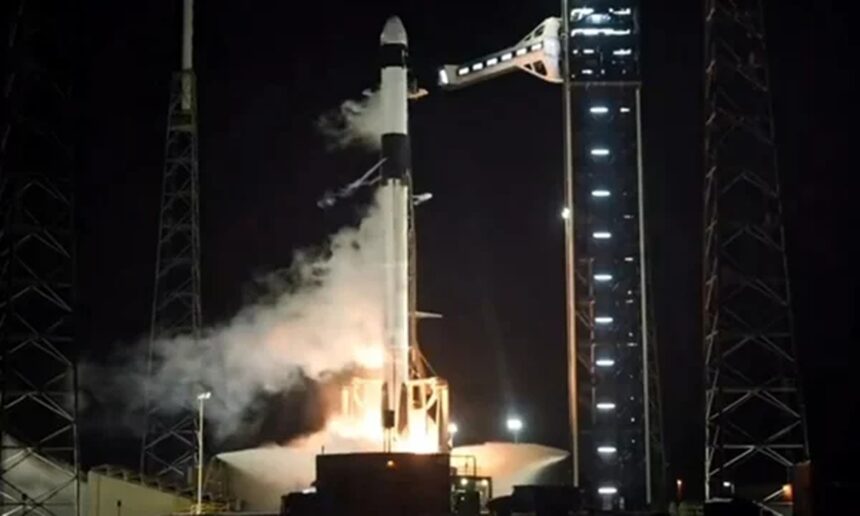
A SpaceX spacecraft carrying four astronauts has launched toward the International Space Station (ISS), beginning a journey that will restore the orbiting laboratory to full staffing after a month of operating with a minimal crew.
The mission, named Crew-12, lifted off from Cape Canaveral Space Force Station in Florida. The spacecraft is expected to dock with the ISS on Saturday afternoon.
NASA, which has contracted SpaceX to transport astronauts to and from the space station, had attempted to expedite the Crew-12 launch due to staffing shortages aboard the ISS. However, the agency was forced to scrub two earlier launch opportunities because of unfavorable weather conditions along the rocket’s flight path.
Since mid-January, the International Space Station has been operating with only three crew members on board — significantly fewer than the standard seven-person crew NASA aims to maintain.
The new launch follows an earlier SpaceX crew mission, Crew-11, which was compelled to make an early return to Earth due to a medical issue.
“NASA was ready. The team responded quickly and professionally, as did teams across the agency, working closely with our commercial partners and executing a very safe return,” NASA Administrator Jared Isaacman said during a press conference in January, adding that the astronaut was in stable condition.
“The reason we train is for moments like this — and this is NASA at its best,” he added.
The early departure of the Crew-11 astronauts left the football field-sized space station staffed by just three crew members: two Russian cosmonauts, Sergey Kud-Sverchkov and Sergei Mikayev, and NASA astronaut Chris Williams, who traveled to the orbital laboratory under a seat-sharing agreement with Roscosmos, NASA’s Russian counterpart.
The situation is not ideal.
NASA has consistently emphasized that maintaining a robust crew presence aboard the ISS is essential to maximizing the laboratory’s scientific value and productivity. The orbiting outpost costs approximately $3 billion per year to operate and maintain.