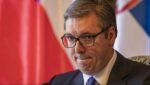
The political maneuvering space for Serbian President Aleksandar Vučić is rapidly shrinking, a trend underscored by his most recent visit to Brussels, where he received what many observers describe as a “reality slap” from EU leaders. The main topics of discussion—rule of law, judicial independence and media freedom—are precisely the areas where Serbia under the SNS-led government has suffered dramatic democratic backsliding.
According to analysts, the message delivered to Vučić was unmistakably clear: “A democratic Serbia is welcome in the EU. The Serbia built under the SNS regime is not.”
Two Minutes for His Proposal, Hours for His Failures
During a dinner meeting at EU headquarters, Vučić attempted to convince European Commission President Ursula von der Leyen and European Council President António Costa of his commitment to the European path—and even tried to revive his long-dismissed idea of a joint Western Balkan entry into the EU.
But as Vučić himself admitted afterward, EU leaders only listened out of courtesy.
“They listened to me like polite people… but said nothing,” Vučić conceded—an indirect acknowledgment that Brussels treated his proposal as irrelevant.
In contrast, the core of the meeting focused on Serbia’s deteriorating judiciary, media repression, and political pressure on prosecutors—issues that have intensified under the SNS government and are central to accusations of state capture.
EU Leaders: Serbia Must Accelerate Reforms—Starting With the Rule of Law
Von der Leyen and Costa publicly emphasized the need for Serbia to accelerate reforms, specifically in the fields of rule of law and media freedom.
While they welcomed Serbia’s steps to diversify energy routes and reduce dependence on Russia, their main message was uncompromising: only a democratic, independent-institution Serbia can move toward EU membership.
For Vučić, this was a striking departure from the praise he enjoyed just a year earlier.As Vučić Negotiates in Brussels, Prosecutors Sound the Alarm in Belgrade
While Vučić was in Brussels, Serbia’s chief prosecutor Zagorka Dolovac and head of the Prosecutorial Council Branko Stamenković were meeting EU representatives in Belgrade—warning of an “intensifying campaign of inappropriate political influence” on prosecutors.
This follows a series of high-profile attacks on judicial independence, including:
- attempts by government-friendly media to discredit prosecutors
- political interventions in sensitive cases
- escalating intimidation within the justice system
Just one day earlier, United Media editors sent a formal letter to EU institutions outlining direct threats to editorial independence—yet another symptom of an environment in which independent media are systematically targeted by the regime.
Analysts: “This Is the Bill for Destroying Institutions”
Vladimir Međak, Vice President of the European Movement in Serbia, summarized the situation bluntly:
“This is the price of destroying the judiciary and media. Democratic Serbia is welcome in the EU. Vučić’s Serbia is not.”
Međak explained that Serbia’s EU prospects now depend on three pillars:
- Rule of law and media freedom
- Geopolitical alignment with the EU, including sanctions on Russia
- Energy diversification
Even if Serbia resolves energy issues and distances itself from Moscow, the collapse of institutions under Vučić remains the decisive obstacle.
“The hollowing out of democratic institutions and the absence of rule of law are the direct responsibility of Vučić and the SNS. Without restoring independence of the judiciary and media, EU membership is impossible,” Međak stressed.
A Major Shift in Brussels’ Tone
The EU’s message in 2025 stands in stark contrast to von der Leyen’s 2024 remarks, when she called Serbia “one of the most advanced” candidate states. Today, such praise has vanished.
Analysts attribute this shift to:
- the changing geopolitical landscape
- declining US engagement in Europe
- growing frustration inside EU institutions with Serbia’s authoritarian drift
- widespread recognition that Vučić’s regime has captured key state institutions, especially the judiciary and media
As Međak noted, even within the EU Parliament, the consensus is growing:
“Serbia cannot enter the EU as long as the SNS is in power.”
The End of Brussels’ Patience
Vučić’s attempt to redirect the conversation toward alternative integration models or regional initiatives failed to mask the central issue: Serbia’s judiciary and media are under systematic political control, and the EU will no longer overlook this reality.
Brussels’ message was firm:
Reform the state, restore rule of law, or Serbia’s EU path remains blocked.