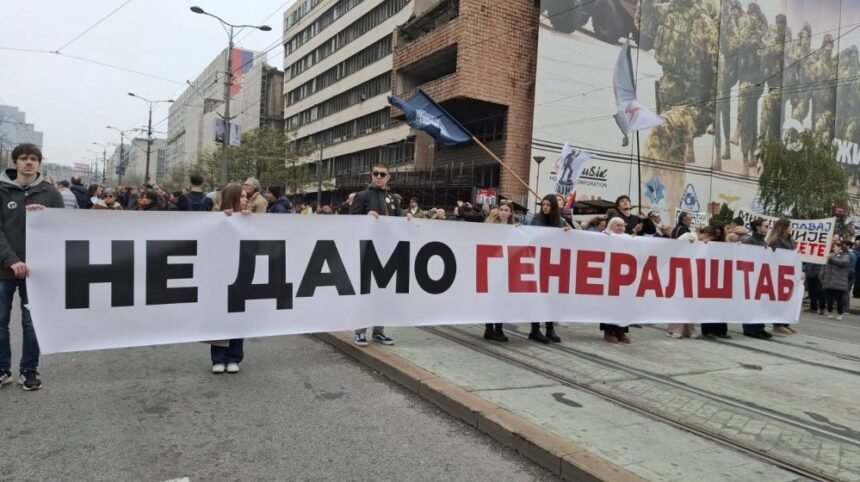
One of the most direct and troubling pressures on Serbia’s judiciary is unfolding around the case of Minister of Culture Nikola Selaković, who is accused of abusing his official position by pushing for the removal of protected cultural status from the historic General Staff building.
Selaković’s legal defense argues that the proceedings should not even exist, citing the recently adopted lex specialis that nullifies the 2005 decision granting the ruined building cultural heritage status. The Minister of Justice has echoed this narrative. However, legal experts and civil society warn that the government is once again crossing constitutional and ethical red lines to shield a top official.
Selaković Dodges Questions, Attacks Journalists
The scandal escalated when KRIK journalist Sofija Bogosavljev questioned Selaković about alleged pressure exerted on officials to strip the General Staff building of its protected status.
Rather than respond, the minister launched personal insults:
- “Are you paid by foreigners?” Selaković snapped at the journalist.
- “Why are you destroying the state? Why are you lying? You are a grand liar.”
His behavior, now seen repeatedly as he avoids the press, has fueled public suspicion that he has something to hide—and that the government is determined to erase accountability.
Government Narrative: Retroactive Laws for the Powerful
Selaković’s attorney Vladimir Đukanović insists that the lex specialis invalidates the entire case, arguing:
“If the 2005 decision is annulled, the building was never truly a cultural asset—so no harm could have been done.”
Legal analysts describe this logic as a dangerous manipulation, noting that the ruling elite appears to believe that laws apply retroactively only when protecting themselves, further eroding rule of law.
Minister of Justice Nenad Vujić publicly supported this argument, calling the prosecution “absurd,” and suggesting that the case will inevitably be dismissed—comments widely criticized as political interference.
Vučić Enters the Stage: Full State Pressure
President Aleksandar Vučić also intervened, claiming the General Staff building is not being sold, only prepared for lucrative long-term leasing.
Despite attempts to frame the issue as economic pragmatism, legal experts warn that the president’s statements represent yet another direct violation of constitutional boundaries, as the Prosecutor’s Office (TOK) has already publicly accused him of interfering in ongoing criminal proceedings.
Sources close to the judiciary fear the government may attempt to dismantle or neutralize the Prosecutor’s Office for Organized Crime (TOK) if it refuses to yield.
More Ministers Implicated
Testimonies from former directors of the Republic Institute for the Protection of Cultural Monuments allege that Finance Minister Siniša Mali also pressured them to commit unlawful acts related to the General Staff building—an accusation that further widens the scandal.
Despite political pressure, institute employees continue to resist, refusing to hand over the keys to the central registry, which would enable authorities to change the building’s status.
Students and Citizens Hold the Last Line
As institutions face unprecedented pressure, the final defense of the General Staff building—and of the rule of law itself—has shifted to students, architects, and citizens who continue to protest.
“Defending the General Staff is defending the dignity of the legal state and our future,”
said Teodora, an architecture student addressing the crowd.
Whether the Prosecutor’s Office will withstand the political assault remains uncertain. But the government’s coordinated effort—spanning ministers, legal proxies, and the president himself—underscores the growing fears that Serbia’s leadership will stop at nothing to protect loyal officials, even at the expense of justice, heritage, and the constitutional order.