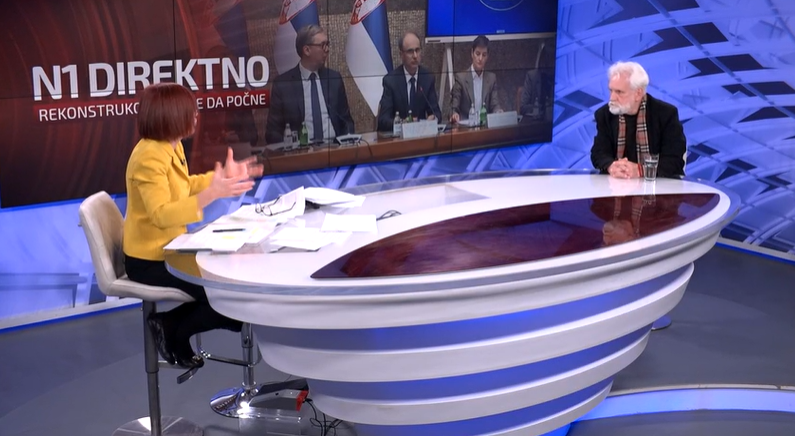
Serbia is likely to hold elections by the end of the year, while recent announcements about a possible government reconstruction are merely pseudo-events designed to distract from more important political processes, according to Zoran Stojiljković, retired professor at the Faculty of Political Sciences.
Speaking on N1 Television, Stojiljković said that pressure on the judiciary, the academic community, and the media represents a clear continuity of the current government’s practices. However, he stressed that the speed and intensity with which these measures are being implemented point to upcoming elections later this year.
“In politics, even for figures such as President Vučić, repeated public announcements that something will happen create a certain obligation,” Stojiljković said.
Public Pressure and the Election Narrative
He noted that the current situation differs from earlier unfulfilled election announcements, as President Aleksandar Vučić has recently faced accusations of avoiding elections out of fear, which, according to Stojiljković, increases pressure on him to follow through.
“In the past, elections were called whenever there was a need to reshuffle power or regain legitimacy,” he explained, adding that the current attacks on independent centers of power suggest preparation for an electoral contest.
Government Reconstruction as a Distraction
Commenting on Prime Minister Đuro Macut’s remarks about a possible government reconstruction in the spring, made only days after Vučić announced elections for the autumn, Stojiljković described the move as manufacturing a pseudo-event.
“You create something that occupies the media and public attention, without producing any real political effect,” he said.
According to him, discussions about who may leave or enter the government serve to obscure far more important political and institutional processes, while creating an illusion of political dynamism within the ruling system.
Pressure, Accountability, and Student Activism
Stojiljković argued that the current pressures have intensified the political climate, leaving no room for further concealment. He voiced support for what he called a ‘shame and blame’ approach, particularly applauding student initiatives demanding transparency and public accountability.
“I have no problem with students publicly showing who is part of the expanded Senate and asking how they voted,” he said, stressing that such actions do not threaten individual freedoms but strengthen democratic accountability.
Hope for Change
Despite the overall critical assessment, Stojiljković expressed cautious optimism, pointing to the student-led movement as a positive development.
“They started in a fascinating way,” he said, noting that students have raised long-neglected issues such as the origin of property and high-level corruption.
He concluded that Serbia has yet to see a single high-level corruption case brought to completion, adding that Minister Salaković currently appears to be the most serious candidate for such a process.