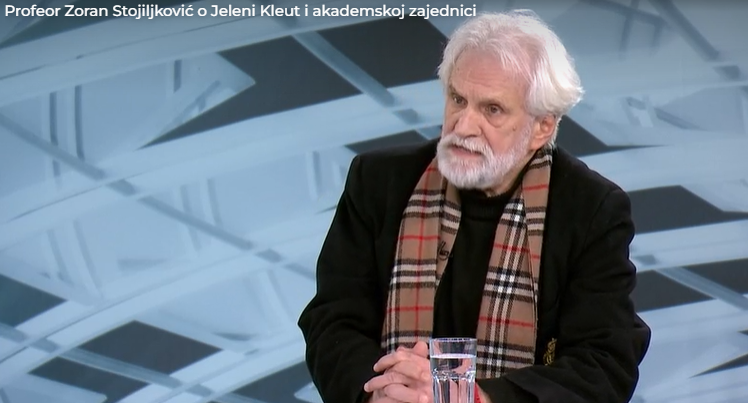
Zoran Stojiljković, retired professor at the Faculty of Political Sciences, says that the case involving Professor Jelena Kleut clearly demonstrates the extent to which the authorities are attempting to silence dissent, control every remaining space of resistance, and punish critics of the regime in what he describes as an “obvious election year.”
According to Stojiljković, Jelena Kleut’s professional reputation, academic achievements, and strong standing among students and colleagues leave no doubt about her qualifications. What is at stake, he argues, is not competence, but political loyalty.
He warns that the ruling structure still controls a significant number of university deans and governing councils, filled with individuals loyal to the regime rather than to academic integrity.
“I am deeply interested in the biographies, knowledge, and educational backgrounds of those people. I would like the names of those who voted secretly to be made public. This is a time when nothing can truly be hidden. The abandonment of impartiality and professional standards is sufficient reason for what could be called lustration,” Stojiljković said.
Loyalty Over Ethics — Even in Academia
Stojiljković stresses that the mentality of loyalty, opportunism, and small personal benefits has penetrated not only universities, but also the Serbian Academy of Sciences, the Serbian Orthodox Church, and other institutions.
He draws parallels with the case of Maja Kovačević, Dean of the Faculty of Political Sciences in Belgrade, who revealed that the Ministry of Education demanded a repeat vote on her appointment, a move she formally appealed.
“This is clearly an attempt to punish Maja Kovačević for her open support of students. The mechanism is being sought through the recycled structure of student parliaments, long dominated by regime loyalists — ‘young soldiers’ of the system who spent decades there and left as unfinished students in their thirties,” he said.
Stojiljković raises a moral question:
“When someone agrees to this, what remains of honor, dignity, or shame when you participate in or silently accept such practices?”
An Election Year Defined by Fear and Pressure
Asked whether shame still plays any role in decision-making, Stojiljković says Serbia is living in a “balance of powerlessness” in a year that is clearly electoral.
He warns of serious dangers, including:
- The shutdown or neutralization of independent media
- Institutional capture
- A blitzkrieg against professional elements within the judiciary
“Some will be blackmailed. Some will be demonized. Some will be intimidated. Others will be reminded of the benefits they received from the regime. Some will be bought off with small financial incentives. And another mechanism is the constant message that ‘nowhere is better’ — which, unfortunately, many people already believe,” he said.
Vučić’s Regime and the Strategy of Apathy
Stojiljković believes that voters may be deliberately pushed into apathy, especially by portraying the student movement — currently the most important opposition force — as unknown and unreliable.
He notes that while the student movement is finally articulating its program, the regime’s counter-message is simple:
“We are predictable. You know what you get with us.”
He warns that exhaustion is setting in, adding:
“When something lasts three years, fatigue inevitably follows. That is why we must wake up.”
Public Accountability, Not Revenge
Stojiljković argues against violence or crude rhetoric, but strongly supports public exposure and accountability.
“This is a personalized political culture. It does not care much for principles, but it understands facts — the fact that massive wealth was accumulated through non-transparent deals, that a vast clientelist network was created, that loyalty became the currency of employment, and that the separation of powers was destroyed. Parliament has been reduced to a talking shop, while prime ministers address the president as ‘boss’.”
He concludes with a fundamental question Serbia must confront:
“What will actually be different after the elections?”