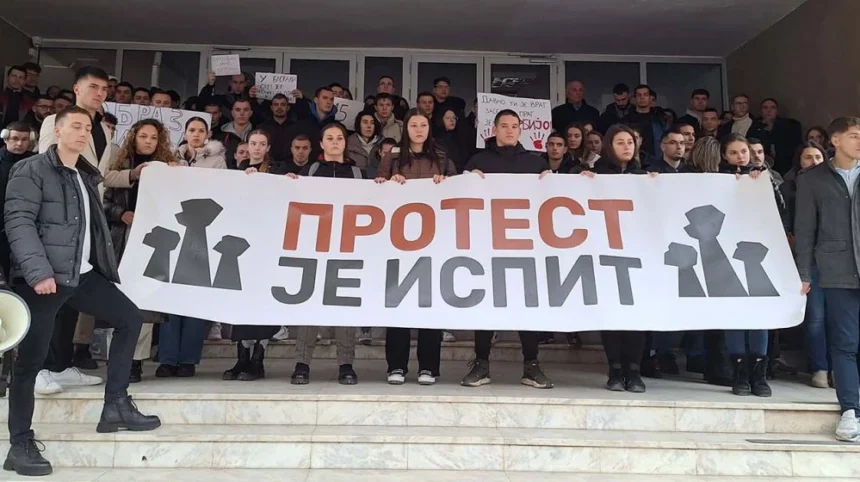
Student plenums in Serbia emerged as a functional system of direct democracy during mass protests and university blockades, despite constant political pressure, according to a study titled “Anatomy of the Plenum.”
The findings were presented at the Independent Journalists’ Association of Vojvodina, where researchers emphasized that plenums became spaces for decision-making, conflict, learning, and collective responsibility.
One of the study’s key conclusions is that the plenum model proved highly effective in disrupting the status quo and building internal solidarity. However, researchers cautioned that its long-term sustainability depends on the ability to evolve from an “emergency mechanism” into a stable organizational structure.
The authors of the study are professors from the Faculty of Philosophy in Novi Sad — Marko Škorić, Jovana Čikić, Jovana Škorić, and Aleksej Kišjuhas.
According to the researchers, a significant number of participants believe that plenum-style decision-making could extend beyond universities into the wider society, a trend already visible through the emergence of citizens’ assemblies.
Jovana Čikić noted that many respondents said they had learned how to listen to others, articulate and defend their positions, and engage in structured discussion.
“The entire plenum system had to be built from scratch, and many participants said it was the first time they had ever heard the word ‘plenum,’” Čikić said.
Aleksej Kišjuhas added that plenums were not only a form of political awakening for students but also a process of personal growth and development.
The study details how decisions were made and power distributed without formal leadership, highlighting a horizontal and participatory structure.
The research was conducted through 26 interviews with students involved in university blockades at the Universities of Novi Sad, Belgrade, and Niš, between March and June of last year.
The panel discussion was moderated by Ivan Marović, president of the Center for Nonviolent Conflict (USA) and a former leader of Serbia’s Otpor movement.