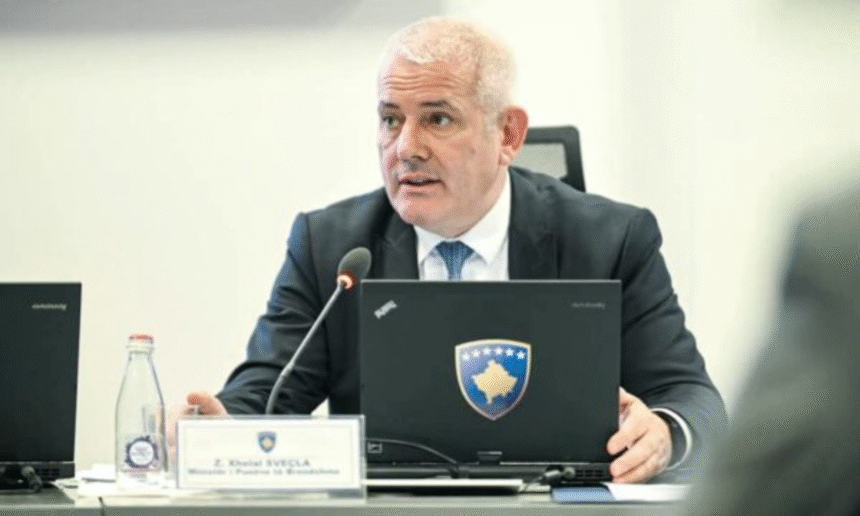
Kosovo’s Interior Minister, Xhelal Sveçla, has strongly condemned statements made by former director of the Serbian Intelligence Service (BIA), Aleksandar Vulin, warning the international community about what he considers direct threats to Kosovo and its leadership.
Vulin recently stated that Serbia could operate in Kosovo “like Mossad operates in Iran”, referencing past actions by the Israeli intelligence agency and claiming that Serbia had previously acted in a similar manner. He added that Kosovo’s Prime Minister, Albin Kurti, “is not afraid of anyone,” framing the statement in a context that blends intimidation with political messaging.
A Dangerous Precedent
Sveçla described Vulin’s remarks as unacceptable and threatening, noting that drawing parallels from high-intensity military and covert operations to Kosovo’s political environment normalizes secretive operations as a tool for destabilization in the Western Balkans.
“Importing analogies from open conflicts with armed operations and applying them to the Prime Minister of the Republic of Kosovo signals an alarming precedent,” Sveçla wrote on Facebook. He highlighted Vulin’s longstanding ties to Russian intelligence and close political alignment with Serbian President Aleksandar Vučić, noting that the former has been placed on U.S. sanctions lists for these connections.
Historical and Regional Context
Sveçla also referenced the documented involvement of Serbian intelligence structures in attacks against Albanian political activists, underscoring the historical dimension of covert operations in the region. According to the minister, the statement that “Serbia knows how to do this” constitutes a direct threat, making international attention essential.
The Interior Ministry linked Vulin’s rhetoric to recent security incidents: in mid-February, Kosovo authorities arrested two Belarusian and one Russian national who had entered the country illegally carrying equipment for surveillance, camouflage, and operational plans. Sveçla noted that these incidents reflect the type of threat suggested in Vulin’s remarks, demonstrating tangible security risks.
Professionalism and Sovereignty
Despite these threats, Sveçla emphasized that Kosovo’s institutions are fully capable of defending the country’s sovereignty and constitutional order.
“This statement represents a direct threat to Kosovo and its Prime Minister. Kosovo’s institutions, operating at a high level of professionalism, will respond to any threat in accordance with the law. Neither Vulin, Vučić, nor external actors can intimidate or stop us,” Sveçla affirmed.
He concluded by calling on international stakeholders to monitor efforts by Russia and Serbia to destabilize the region and to recognize Kosovo’s commitment to maintaining its independence and security.
Implications for Regional Security
Vulin’s comments, whether intended as political posturing or a signal to certain domestic audiences in Serbia, highlight a broader security concern: the potential for covert influence operations and intimidation campaigns targeting Kosovo’s leadership. Analysts suggest that such rhetoric is part of a continuing pattern of Serbia leveraging historical grievances and foreign alliances, particularly with Russia, to exert pressure in the Western Balkans.
For Kosovo, the situation reinforces the importance of maintaining robust intelligence, law enforcement capabilities, and international partnerships, ensuring that threats—both rhetorical and operational—do not translate into destabilizing actions.