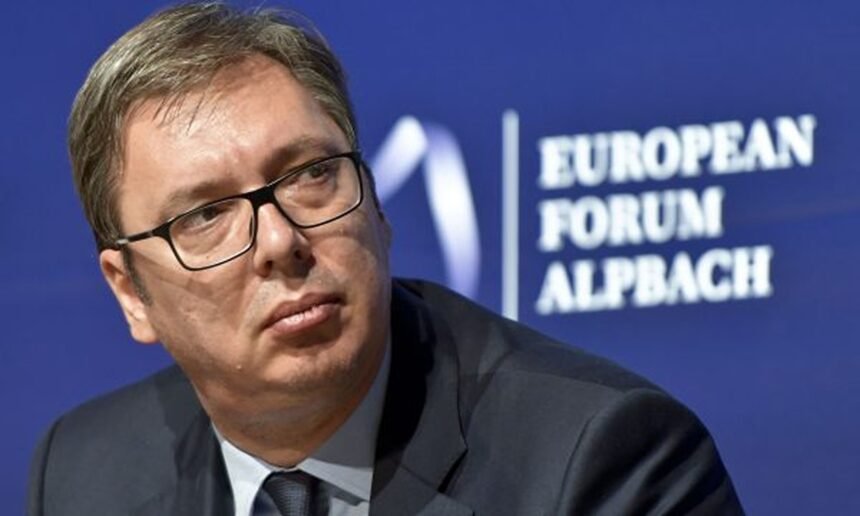
Media freedom in Serbia is steadily deteriorating as the country faces ongoing student-led protests against corruption and the increasingly authoritarian tendencies of President Aleksandar Vučić. This is reported by the Swiss public broadcaster RTS, which highlights that for more than a year journalists and independent media outlets have been subjected to intensified attacks, as well as political and economic pressure.
According to the report, covering anti-corruption protests has become a high-risk activity for journalists in Serbia. They are regularly attacked, both while reporting in the field and through other forms of pressure. Among them is Ksenija Pavkov, a journalist with N1 Television, a media outlet currently under constant scrutiny by the authorities, reports albinfo.ch.
“It often happens that pro-regime hooligans throw stones, bottles, or other objects at us, while the police fail to react and protect us,” Pavkov said in an interview for RTS’s morning program. “In addition, we are constantly exposed to insults, threats, and even death threats.”
Journalists Labeled as “Terrorists”
According to RTS, President Aleksandar Vučić frequently refers to critical journalists as “mercenaries” or “terrorists,” fostering a hostile environment toward independent media. This situation is particularly severe in cities outside the capital.
“Journalists who do not support the regime are systematically smeared by pro-government tabloids,” said Zoran Knežević, editor-in-chief of Radio 021 in Novi Sad. “These outlets publish details from their private lives and continuously fabricate falsehoods.”
“Complete Lack of Transparency”
According to Milica Šarić, director of the Center for Investigative Journalism of Serbia, investigating the clientelist system denounced by protesters for more than a year has become nearly impossible, reports albinfo.ch.
“It has never been this difficult to do investigative journalism,” she said. “Authorities refuse to grant us access to public documents. Everything is shrouded in a lack of transparency and secrecy.”
The international organization Reporters Without Borders has already described Serbia as “the weakest link in Europe” when it comes to media freedom.