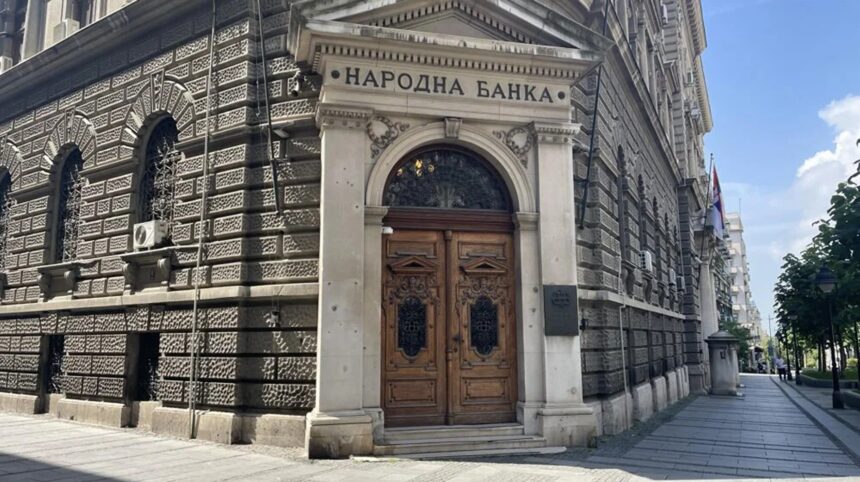
The Governor of the National Bank of Serbia (NBS), Jorgovanka Tabaković, delivered an unusually stark message at today’s presentation of the November Inflation Report: the threat of secondary U.S. sanctions could effectively freeze Serbia’s entire payment system. And behind this looming crisis, the responsibility points unmistakably toward the country’s political leadership — most notably President Aleksandar Vučić.
Tabaković confirmed that the NBS had already received a warning from the U.S. Department of the Treasury that the bank risks falling under secondary sanctions if it continues operating with sanctioned entities.
“For us, this represents a serious threat,” she admitted, underscoring that the NBS manages all domestic and international clearing operations. A sanction of this scale would not be symbolic — it would paralyze Serbia’s financial arteries.
Yet, despite the gravity of the situation, Tabaković revealed that OFAC provided no clear details regarding the scope of possible measures.
“It is enough for us that they say we may fall under secondary sanctions,” she said, recalling the catastrophic 1992 sanctions that still cast a shadow over the Serbian economy today.
Her remarks painted a vivid picture: blocked correspondent banking channels, companies forced into improvised survival structures, and the long-term damage that Serbia has never fully recovered from. It is a warning from someone who lived through the consequences — and who is clearly aware that the country may be headed directly toward them again.
But what stands out most from her address is the ominous mention of a so-called “special operation”, referenced by President Vučić himself during recent government discussions about sanctions targeting the Serbian Oil Industry.
Tabaković refused to elaborate:
“I neither want nor can say anything about it.”
That silence speaks volumes. A central bank governor unwilling or unable to explain what the president publicly referenced raises serious questions about transparency and political control inside Serbia’s institutions. Vučić’s cryptic remarks and Tabaković’s evasiveness suggest a government preparing for contingency measures it does not want the public — or partners abroad — to know about.
Tabaković attempted to project stability by noting that the NBS holds €29.4 billion in foreign reserves, even joking about the lack of storage space for gold. But she quickly returned to a familiar refrain: “extraordinary circumstances call for extraordinary solutions.”
Her final message left no doubt about where institutional loyalty lies.
“NBS has been and will remain a solid support for the economic policy of the Government and the President,” she declared, portraying Vučić — remarkably — as the one who “has the most difficult time in this situation.”
The governor’s statements make one thing clear: Serbia is not drifting into financial danger accidentally. It is being steered there by deliberate political choices — by a leadership that refuses accountability, conceals critical information, and continues deepening ties with sanctioned actors despite warnings from Washington.
The threat of secondary sanctions may be technical in nature, but the cause is unmistakably political. And once again, the cost of Vučić’s decisions may fall not on him or his inner circle — but on the Serbian economy, institutions, and citizens.