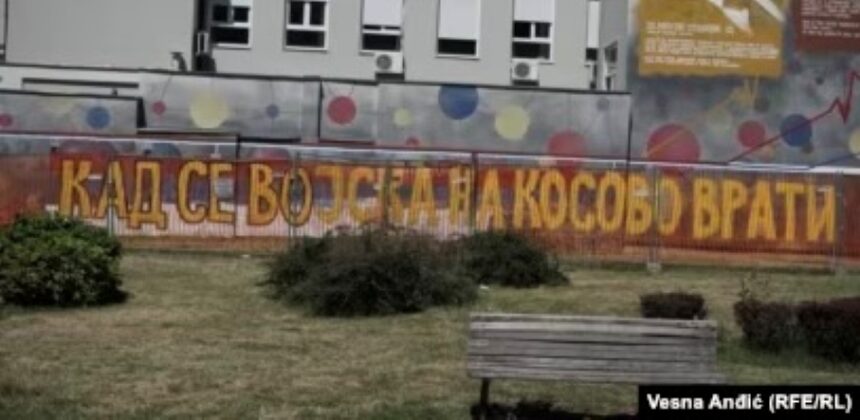
A school teacher and opposition activist in southern Serbia has been fined €25 after covering nationalist graffiti reading “When the army returns to Kosovo” located in the yard of a primary school where he works, sparking political and public controversy.
Teacher Says Graffiti Promoted Conflict and Intolerance
Dejan Petrović, 54, a teacher at the “Učitelj Tasa” Primary School in Niš, stated that the graffiti had been present for several years and promoted messages that could encourage conflict and revive tensions from the 1990s.
“This graffiti calls for war and conflict. This message takes us back to the 1990s, a time when Serbia was losing young lives and territory,” Petrović told Radio Free Europe (RFE/RL).
Petrović explained that he had previously raised concerns with the school’s administration about the message being inappropriate for an educational environment. According to him, after receiving no response, he interpreted the silence as approval to remove it at his own expense.
Together with colleague Rastislav Dinić, a member of the Green-Left Front (ZLF), Petrović painted over the graffiti during the weekend when no students were present.
Anonymous Complaint Leads to Fine
Several days later, municipal police summoned Petrović following an anonymous complaint, accusing him of altering property without authorization. He was subsequently fined €25.
Authorities and the school administration have not publicly commented on the case, despite inquiries from media outlets regarding how such graffiti is treated under laws related to hate speech or public disorder.
Under Serbian regulations, municipal authorities are responsible for removing graffiti from public spaces, while private property owners are responsible for graffiti removal from their own buildings.
Ruling Party Condemns the Action
Serbia’s ruling Serbian Progressive Party (SNS) strongly criticized the removal of the graffiti, describing the activists as “self-chauvinists.”
Miloš Vučević, leader of the ruling party and former prime minister, described the act as “scandalous,” accusing the activists of harboring anti-Serbian sentiments.
“They hate everything Serbian, including our army and Kosovo and Metohija,” Vučević said in a video statement shared on social media platform X.
Historical and Political Context
The slogan “When the army returns to Kosovo” has appeared widely across Serbia in recent years and is considered by civil society activists to be a nationalist message that fuels division. Activists have repeatedly attempted to remove similar graffiti across the country, often facing fines or legal challenges.
Serbian military and police forces withdrew from Kosovo in 1999 following NATO’s intervention during the Kosovo War. Kosovo declared independence in 2008, a move that Serbia continues to reject.
Legal Dispute Over Political Activity in Schools
Local SNS officials in Niš have accused activists involved in the graffiti removal of violating Serbian education laws, which prohibit political party activities within educational institutions.
However, Petrović denied the accusations, emphasizing that the action took place during the weekend without students present and was intended to improve the school environment.
“We acted in the interest of the children and the entire school community,” he said.
Broader Debate Over Public Murals and Nationalist Symbols
The case highlights ongoing tensions in Serbia over nationalist symbols and murals, including those glorifying convicted war criminals. Civil society organizations have filed hundreds of requests for removal of such imagery, with mixed responses from authorities and courts.
Several Serbian courts have previously ruled in favor of activists accused of removing controversial murals, stating that violations were not sufficiently proven.
Human rights groups argue that citizens have both the right and responsibility to remove illegal graffiti promoting hate or violence, while critics warn such actions risk escalating political polarization.