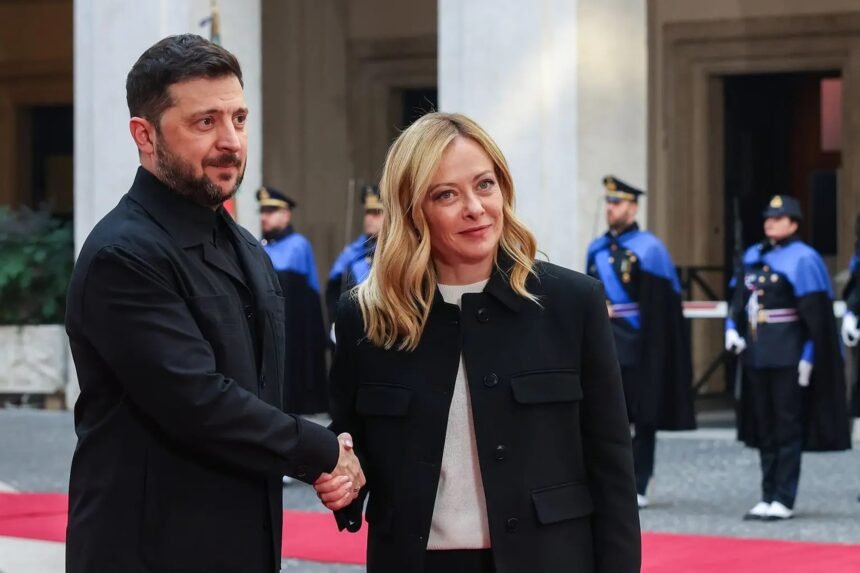
Behind the façade of a “constructive meeting built on mutual trust,” and far from the polished official statements, the 90-minute encounter between Giorgia Meloni and Volodymyr Zelensky told a very different story. A story in which the Italian side made its pressure on the Ukrainian delegation unmistakably clear. Meloni’s core message can be summarized bluntly: “Prepare yourselves painful concessions may be inevitable.”
The discussions, which lasted an hour and a half, were preceded by a closed-door meeting between Meloni and her Ministers of Defense and Foreign Affairs, Guido Crosetto and Antonio Tajani, alongside parallel one-on-one talks between the two ministers and their Ukrainian counterparts. The entire afternoon at Palazzo Chigi was anything but calm.
And for at least three reasons:
- Italy supports the pressure the United States is exerting on negotiations;
- Meloni’s staff is increasingly convinced Zelensky has been politically weakened by ongoing corruption investigations inside his own government;
- The Italian government insists its role is to secure a “fair and sustainable” peace plan while clearly acknowledging Washington’s leadership, not Europe’s.
Details from the meeting show Meloni applying a kind of moral pressure on Zelensky, reportedly even on behalf of the White House. Meanwhile, Zelensky was doing the opposite pressing Meloni to soften Trump’s stance and to counter what appears to be a firm American push for a rapid peace deal.
That same evening, Zelensky even spoke openly about the possibility of new elections a move seen more as a challenge than a concession, adding yet another layer of complexity to the already fragile negotiation process.
Equally telling were the public remarks of Ukrainian Foreign Minister Andrii Sybiha. Speaking at Palazzo Chigi, he politely laid out a list of expectations from Italy:
- A stronger and more proactive role in unfreezing Russian assets held in Belgium;
- A clearer position on the stalled PURL program;
- Participation in the U.S. weapons procurement scheme already joined by more than 15 EU states but not Italy;
- And even the reallocation of certain European Safe funds, which are designed to strengthen EU member states’ armed forces, toward military aid for Ukraine.
Italy is one of only four countries out of nineteen that refuse to redirect a portion of these funds toward military support for Kyiv.
All signs point to a meeting that did not go smoothly. Both sides expressed significant differences—some for the very first time. Moreover, Meloni continues to appear, at least in the eyes of Italy’s Democratic Party and the broader opposition, with “one foot in each camp”: aligned with Europe’s efforts to defend Kyiv, resisting diplomatic pressure from Washington yet still unwilling to distance herself from the hardline tone Trump is imposing on the ongoing negotiation agenda.