Reserved seats for minority communities in the Assembly of Kosovo: constitutional protection of political representation or an instrument for political manipulation?
This question has returned to the spotlight after Emillija Rexhepi, chairwoman of the New Democratic Party representing the Bosniak community, accused Nenad Rashiq, leader of the Serbian Freedom, Justice and Survival Party, of “vote manipulation” after he received around 200 votes in several villages in the Prizren municipality where no ethnic Serbs live.
“Reserved, or guaranteed, seats exist precisely to ensure that minority communities elect their authentic representatives. Anything else constitutes a gross exploitation of the system and directly undermines the constitutional purpose of reserved mandates,” Rexhepi said in a statement released after Kosovo’s Supreme Court dismissed her complaint, arguing that “it cannot decide who voted for whom, and every citizen has the right to vote for whoever they wish.”
In an interview with Radio Free Europe, Rexhepi said that her party achieved a good electoral result, but emphasized that it is the responsibility of political representatives to protect the interests of their community and guaranteed mandates.
She also pointed out that the “Vakat” coalition, which also represents the Bosniak community, received votes in villages inhabited only by Albanians, and warned that the matter would be taken to the Constitutional Court of Kosovo.
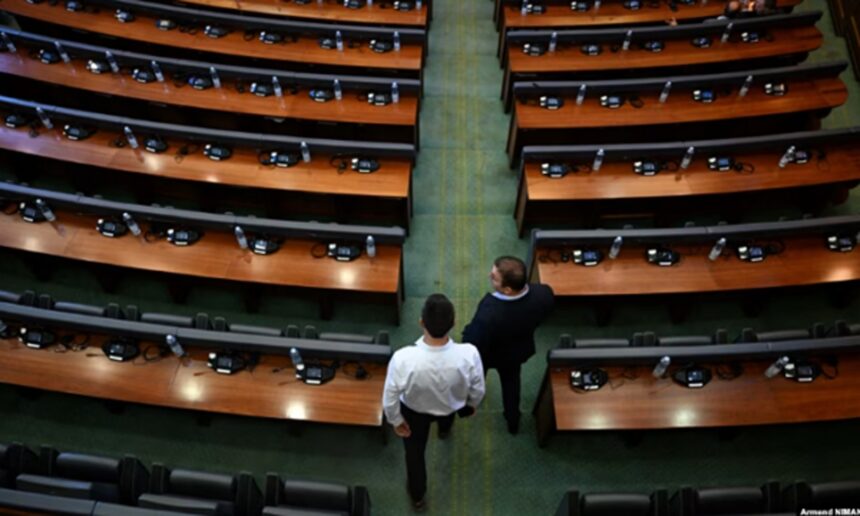
Out of 120 seats in the Assembly of Kosovo, twenty are reserved for minority communities: ten for the Serb community and ten for other communities residing in Kosovo.
The Bosniak community has three seats, the Turkish community two, the Roma, Ashkali, and Egyptian communities one each, plus one additional seat for the most voted member among the Roma, Ashkali, and Egyptian communities, while one seat belongs to the Goran community.
According to final results from the Central Election Commission, Emillija Rexhepi’s New Democratic Party secured one seat with 3,920 votes from the December 28 elections, while the Serbian Freedom, Justice and Survival Party also won one seat with 4,862 votes.
Rexhepi served as Deputy Prime Minister for Communities in the previous government, while Rashiq led the Ministry for Communities and Returns after the Serbian List—the largest party representing Serbs in Kosovo, supported by Belgrade—boycotted Kosovo’s institutions in November 2022.
Rashiq Rejects Accusations
Nenad Rashiq denied accusations of manipulation or political engineering, emphasizing that, as a former Minister for Communities and Returns, he was in contact with various communities in Kosovo and earned their trust.
In an interview with Radio Free Europe, he said that the situation cannot be compared to Adriana Hoxhiq of the United Community Initiative in 2021. At that time, Kosovo’s Supreme Court annulled over 4,000 of her votes in Serb-majority municipalities, causing her to lose her parliamentary seat.
Similarly, the Supreme Court annulled over 800 votes for the Roma Initiative, leaving the party with only one of its two parliamentary seats.
These two parties were accused of receiving votes in Serb-majority areas thanks to the Serbian List, which “through its voter base, tried to exert influence and control over several minority communities in Kosovo.”
Regarding the votes for the Roma Initiative, the Kosovo Roma Union and the Egyptian Liberal Party appealed to the Constitutional Court, which in 2023 confirmed that minority members have the right to receive votes anywhere in Kosovo—without ethnic discrimination—as long as there is no evidence of electoral irregularities.
Any annulment of votes must be based on clear legal arguments and evidence, such as coordinated electoral fraud.
Rashiq emphasized that the number of votes he received in areas without Serbs is small and does not affect his electoral outcome.
“Adriana Hoxhiq, in 2021, received 70% of the votes in areas where she traditionally had none. We all know what manipulation took place then,” Rashiq said.
He added that he sees “no logic” in Rexhepi contesting his votes and insisted that reserved minority seats were never at risk.
Allegations of Orchestrated Voting
Rexhepi, however, described the situation as “orchestrated voting” and questioned the purpose of reserved mandates if parties compete for votes outside their communities.
“The constitutional right must be preserved. This is not observed in Kosovo’s multiethnic cities; the complaint only concerns areas where a specific ethnic community lives,” she said.
She also recalled that Ena Kadaj Krasniqi’s candidacy on the Vakat coalition list was not confirmed, as it was not proven that she was an “authentic representative of the Bosniak community.”
Earlier, the Serbian List had also accused Rashiq of winning a parliamentary seat “thanks to Albanian votes.”
Expert Analysis
Ehat Miftaraj of the Kosovo Justice Institute told Radio Free Europe that Rexhepi’s concerns about reserved seats are legitimate and politically understandable, but her claims are not based on constitutional or legal regulation, nor on established practice.
“The Supreme Court’s decision follows the precedent in the Veton Berisha case. Both the Supreme Court in 2021 and the Constitutional Court in 2023—regarding Berisha—ruled that votes for minority community representatives cannot be annulled simply because they come from another community. Vote annulment is only permitted in cases of proven coordinated schemes or electoral crimes that threaten minority representation rights in Kosovo,” Miftaraj explained.
He added that annulling Rashiq’s votes simply because they were cast in non-Serb areas would violate the Constitution of Kosovo.
“This would impose ethnic boundaries on voters’ political will—a principle the Constitutional Court has explicitly rejected,” Miftaraj said.
Election Results of Kosovo’s Main Parties
According to the Central Election Commission, Vetëvendosje won 51.10% of votes in December elections, securing 57 seats. The Democratic Party of Kosovo won 22 seats, the Democratic League of Kosovo 15, and the Alliance for the Future of Kosovo six.
Certification of results was delayed until February 9 due to vote recounts amid allegations of manipulation.
The constitutive session of Kosovo’s Assembly is scheduled for Wednesday, February 11.