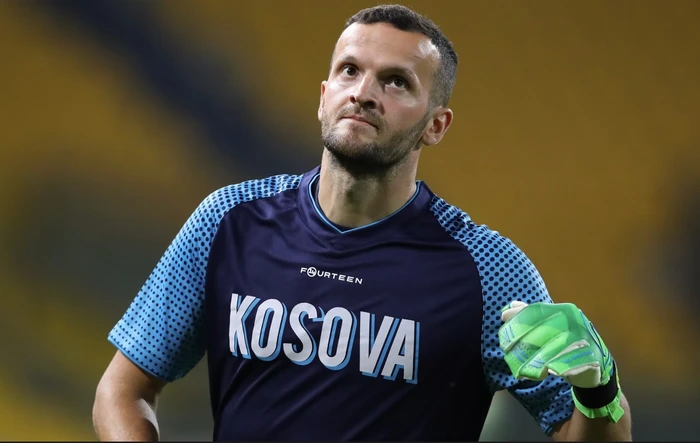
The Balkan nation became a member of FIFA only in 2016, but a victory against Turkey would secure its first-ever place in the World Cup finals, writes The Guardian, which published a lengthy interview with Kosovo legend Samir Ujkani and former federation secretary Eroll Salihu.
“We didn’t even know each other.” Ujkani recalls March 2014, when an improvised Kosovo team largely assembled from lesser-known leagues across Central Europe and Scandinavia gathered to face Haiti in the country’s first official match.
At the time, Ujkani was something of an exception: an experienced Serie A goalkeeper for Palermo and a former Albania international, willing to take a chance on what would become one of international football’s most remarkable stories.
“I can say without doubt that at the beginning I didn’t know 50% of the players’ names. It was really difficult, but in our hearts we always tried to improve and believe in each other,” Ujkani said.
Back then, Kosovo could hardly have imagined what lies ahead now. A win over Turkey on Tuesday night would send them to the World Cup—a sentence that would have seemed unimaginable just 12 years ago, when they struggled to a goalless draw against one of the few nations willing to face them. At that time, the ultimate goal was recognition from FIFA and UEFA, giving global legitimacy to a country that declared independence in 2008.
The early days were far from easy. Kosovo often trained on a worn-out pitch near the KEK power plants outside Pristina, among the most polluted in Europe. Other times, they made three-hour round trips to Mitrovica just for a single training session.
“We didn’t care. We did everything, and nobody complained. I’m very proud of what the team is achieving now,” Ujkani added.
Football in Kosovo had once been suppressed during the 1990s, when public matches were banned under Serbian authorities following the breakup of Yugoslavia. After the war, the sport became a powerful symbol of identity and a way to present a new image of the country to the world.
“If something had gone wrong against Haiti, I feared someone would misuse it and say Kosovo couldn’t organize a proper match,” said Salihu, who worked closely with the late Fadil Vokrri to secure Kosovo’s place in international football through years of diplomatic effort.
Kosovo was officially admitted to FIFA and UEFA in May 2016. Salihu remembers the emotional moment when they realized they had enough votes. “Fadil shivered,” he said. “He told me: ‘Eroll, it’s happening.’ And then he started crying. I had never seen him cry before, and then I started too.”
Vokrri, a beloved striker for FC Prishtina and Partizan Belgrade, passed away in 2018. Today, Kosovo plays in the renovated stadium that bears his name—the Fadil Vokrri Stadium—in front of nearly 14,000 fans.
Since those early struggles, Kosovo has transformed into a competitive side. Under German coach Franco Foda, appointed in 2024, the team has developed discipline and unity.
“He gave us that push,” said Ujkani. “He’s a real commander and put us on the right path with good tactics. We always had talent, but now we also have team spirit.”
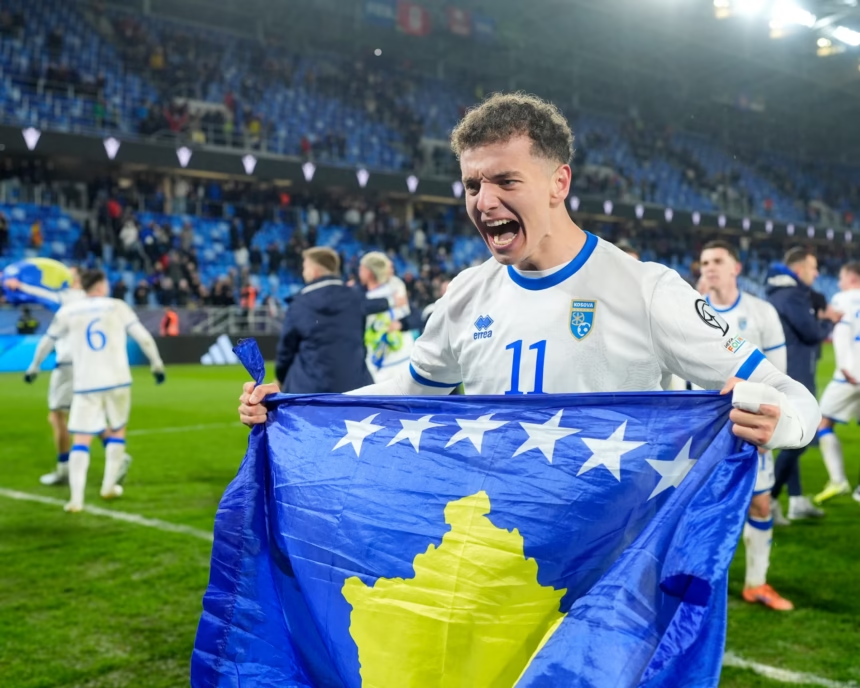
Led on the field by players like Vedat Muriqi, Kosovo has impressed with victories over Sweden and Slovenia and a dramatic playoff win in Slovakia. With talents such as Edon Zhegrova and Fisnik Asllani, a nation of just 1.6 million has produced a remarkable pool of players.
There is also historical meaning in facing Turkey again. Shortly after Kosovo’s first match, Turkey visited and won 6–1, at a time when few nations were willing to play them.
“We never forget,” Salihu said. “They said they would come even if they had to stay in people’s homes.”
Now, gratitude remains—but so does ambition.
“This is not just for the players, coaches or the federation,” Ujkani said. “It’s for everyone from Kosovo and for all those who fought for us to be where we are today. It’s like a dream come true.”