Twenty-seven years have passed since one of the gravest massacres in Kosovo the event known as the Racak Massacre, which took place on 15 January 1999 shook the conscience of the world and prompted international action.
The massacre occurred in Račak, a village in the Municipality of Shtime in central Kosovo. Forty-five villagers were killed and brutally massacred. Despite the scale and gravity of the crime, only one individual has ever been found guilty for participation in the massacre by judges of the United Nations Mission in Kosovo (UNMIK).
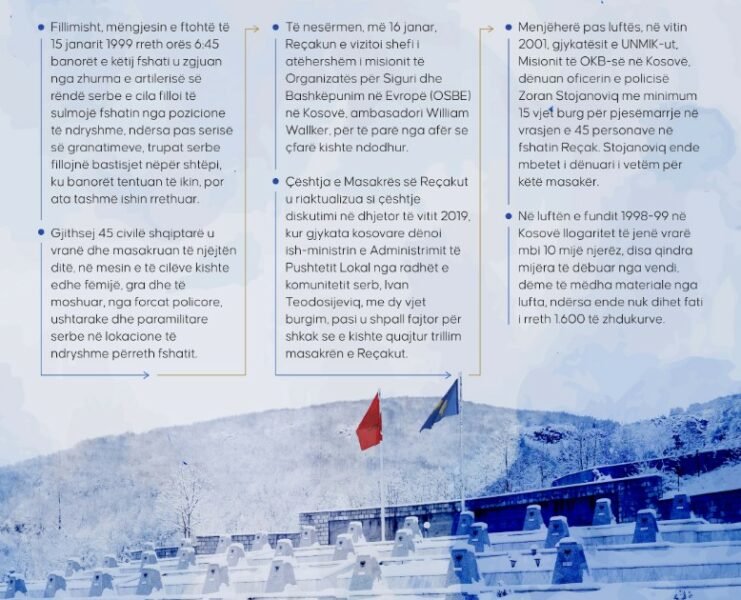
On the cold morning of 15 January 1999, at around 6:45 a.m., residents were awakened by the sound of heavy Serbian artillery shelling the village from multiple positions. Following the bombardment, Serbian forces began raiding homes. Villagers attempted to flee, but the village had already been surrounded.
Later that day, 24 men, who had been hiding in one of the village houses, were taken out, lined up, and escorted by Serbian forces. While walking together, they were executed at close range with automatic weapons and massacred at a site known as “Bebush’s Gully”. In total, 45 Albanian civilians, including children, women, and the elderly, were killed and mutilated that same day by Serbian police, military, and paramilitary forces at various locations around the village.
“This is the most tragic event of my life”
On 16 January, the day after the massacre, Ambassador William Walker, then head of the OSCE Mission in Kosovo, visited Račak to see firsthand what had occurred.
After touring the village and reaching the site known as Bebush’s Gully where the Racak Memorial Complex stands today, Ambassador Walker was horrified by the scenes of the bodies. Without hesitation, he declared:
“From what I saw, it was evident that this was a massacre and a crime against humanity. This is the most tragic event of my life.”
This moment became a turning point that irreversibly changed the course of Kosovo’s history. After failed diplomatic efforts to reach an agreement with Serbia, the democratic world launched NATO’s 78-day bombing campaign on 24 March 1999.
On the anniversary of the massacre, former OSCE Ambassador William Walker is expected to publish his book titled “Racak”, sponsored by the Government of Kosovo. Walker wrote the book based on his personal experience as a witness to the massacre, as he stated, “before I go to the other world.”
The Racak Massacre revisited in 2019
The issue of the Racak Massacre was revived in December 2019, when a Kosovo court sentenced Ivan Todosijević, former Minister of Local Government Administration from the Serbian community, to two years in prison after finding him guilty of calling the Racak Massacre a fabrication.
Following this ruling, Serbian President Aleksandar Vucic also labeled the Racak Massacre as a fabricated crime and accused Ambassador Walker of falsifying it.
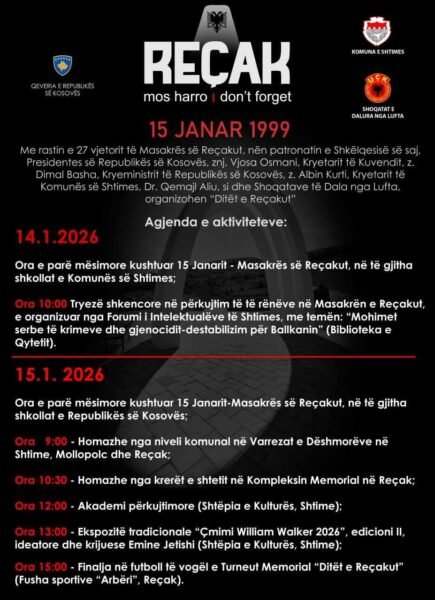
Kosovo’s then Acting Prime Minister Albin Kurti responded by stating that Serbia continues its efforts to deny its role in the massacre.
“When the truth is as powerful as that of the Racak Massacre, denial narratives also emerge just as Serbia has done from the day of the massacre until today seeking to obscure and falsify the direct planning and execution role of the Serbian state in carrying out the Racak Massacre,” Kurti said.
The massacre of Kosovo Albanians in Račak was condemned by the United Nations Security Council.
Immediately after the war, in 2001, UNMIK judges sentenced Serbian police officer Zoran Stojanović to a minimum of 15 years in prison for participation in the killing of 45 people in Račak. He remains the only person convicted for this massacre.
During the 1998–1999 war in Kosovo, more than 10,000 people were killed, hundreds of thousands were forcibly displaced, vast material damage was inflicted, and the fate of approximately 1,600 missing persons remains unknown.