Kosovo’s Law on Foreigners has surfaced a deeper question that the “survival” discourse was designed to obscure: what exactly is being preserved, and for whom?
The recent implementation of Kosovo’s Law on Foreigners has reignited debate over the presence and role of Serbian institutions in North Mitrovica, exposing a deeper question that the “survival” narrative has long sought to obscure: what exactly is being preserved, and for whom?
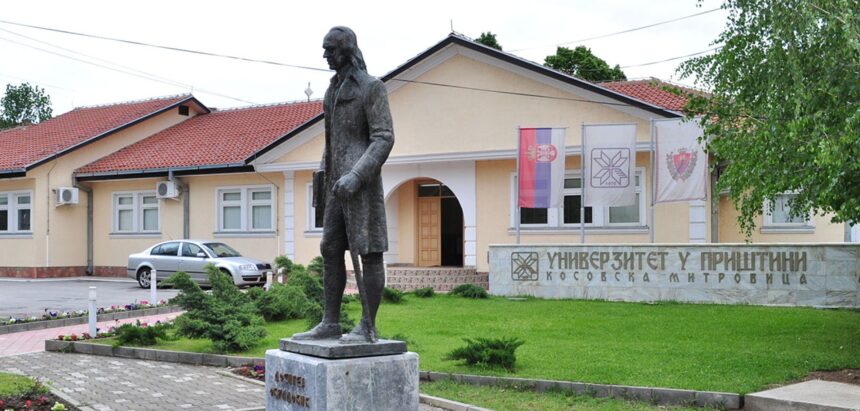
In public statements to Serbian media, officials and academics in North Mitrovica have framed the survival of Serbs in Kosovo as dependent on parallel institutions. Slobodanka Perić, Dean of the Faculty of Law at the University of Prishtina with temporary seat in Kosovska Mitrovica (UPKM), described the university and the Serbian health system as “the umbilical cord connecting us with our homeland Serbia” and argued that “the university and health system represent the pillar of Serb survival in ‘Kosovo and Metohija’” (Serbian TV, 2026).
Similarly, the dean of the Faculty of Economics at UPKM compared the position of Serbs in Kosovo today to their situation under Ottoman rule, framing the debate as a question of communal survival rather than sovereignty or legality.
However, a closer examination of these claims raises critical questions. The institution officially known as the University of Prishtina with temporary seat in Kosovska Mitrovica is fully funded by Belgrade, follows a Serbian curriculum, and awards Serbian degrees. Its “temporary” designation has persisted since 1999, making it less a transitional measure and more a permanent claim over territory.
Under Kosovo’s constitution and legal framework for minorities, Serbs already enjoy extensive protections: reserved seats in the Assembly, guaranteed municipal competencies, official language status, and access to education in Serbian at every level. The argument that “Serb survival requires Serbian institutions” ignores these provisions, treating them as nonexistent—an omission that is itself politically significant.
The practical consequences of this parallel system are stark. Graduates of North Mitrovica’s Serbian institutions cannot sit Kosovo’s bar exam, register with its medical chamber, or be licensed by other professional bodies in Kosovo. In effect, their professional and civic existence depends entirely on Belgrade’s continued funding of the enclave. What the dean calls an “umbilical cord” can equally be seen as a leash, tethering citizens to an external state rather than integrating them into the state where they reside.
Legal analysts argue that Kosovo cannot indefinitely permit a foreign state to operate institutions on its territory. These parallel systems are not minority rights; they constitute a sovereignty issue. By enforcing the Law on Foreigners, Kosovo has forced this question into the public arena, challenging the long-standing narrative of “survival” that has guided North Mitrovica’s Serbian institutions.
As the Law on Foreigners comes into effect, the state faces a critical choice: either allow the parallel structures to persist under external control, or assert sovereignty while upholding minority rights within Kosovo’s constitutional framework.