A Front Against the “Bismarck” Brutalities
As students refuse coordination or coexistence with the opposition — and as both sides operate on different battlefields — the consolidation of Serbia’s opposition would be more than welcome at a moment when state-sponsored terror is becoming impossible to contain without the full mobilization of a society in revolt.
Escalating Threats and State-Backed Violence
A day before the Ćacilend thugs emerged with sticks and a clear intention to assault opposition MPs, MP Slavica Radovanović reminded the public that she had earlier been attacked inside Parliament by Marko Kričak. When she asked Speaker Ana Brnabić what the state planned to do to protect MPs, Brnabić offered a rehearsed reassurance that Radovanović was “completely safe.”
Two days later, the threat of slaughter was instead delivered to MP Biljana Đorđević — this time by Vladimir Balać, portrayed by pro-government media as an exemplary student. Meanwhile, regime-aligned activist Simo Spasić used a megaphone to threaten all opposition MPs, saying he would “impale them on stakes.”
Despite these threats, the ruling party dismissed the evidence presented by the opposition as fabricated. Brnabić’s so-called “proof” relied on the absurd claim that the man known as “Bismarck” — the student threatening to “butcher” people — would never reveal his name during a crime. This ignored the fact that none of the Ćacilend attackers fear identification, because they enjoy full political and judicial protection from the SNS, Ivica Dačić, Dragan Vasiljević and Nenad Stefanović.
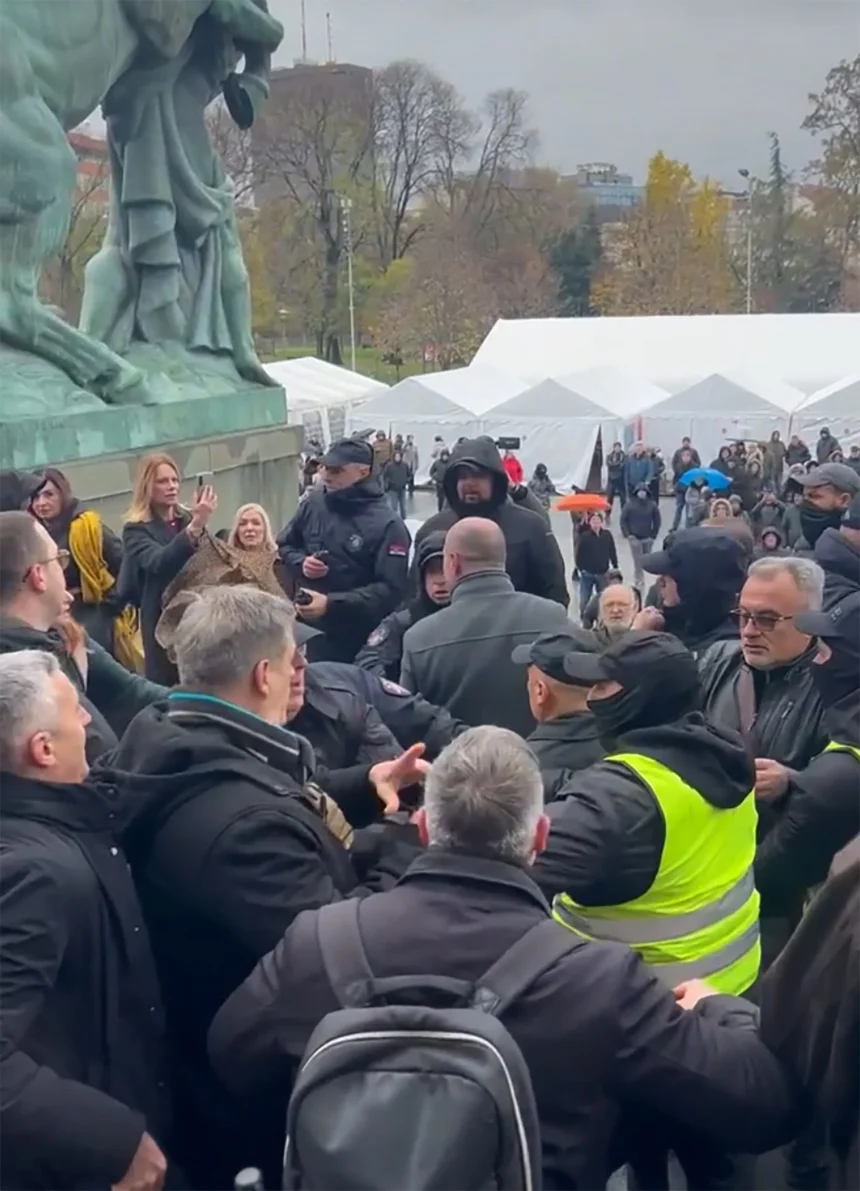
That became clear on 26 November, when Ćacilend militants attacked opposition MPs at Parliament’s entrance without suffering any consequences.
Opposition Forced Out of Illegality
Despite the regime’s deployment of para-military force, the opposition succeeded — after three days — in reclaiming its right to enter Parliament, forcing even Ana Brnabić to allow access without harassment from the newly installed “hosts” of the illegal camp.
For some citizens, this was a small victory. Others immediately complained that the opposition was “drawing attention to itself” and “stealing support from the students.”
But how did Serbia end up here in the first place?
A Failed Strategy of Retreat
Whoever advised the opposition to withdraw from Parliament, go underground, and effectively abolish itself — waiting for the student movement to magically win undefined future elections — gave disastrous advice.
Students cannot defend society alone, nor can they protect themselves when the regime has opted for brute force as its primary tool. President Aleksandar Vučić’s celebratory toast after the local elections — “toward final victory” — is an ominous warning: the regime now seeks dominance over universities, the JTOK, the judiciary, and perhaps even individual households.
Different Battlefields, One Struggle
Students have one arena — the streets and protests.
The opposition has another — Parliament, courts, and institutional mechanisms, including the fight over the Generalštab.
This is why opposition consolidation is vital. A united and professional front proved highly effective during the European Parliament session, which produced the sharpest-ever resolution on Serbia and the first serious signal from the European Commission that Vučić’s violations of freedoms and rights will no longer be tolerated.
Can a United Opposition Survive?
Political scientist and ZLF MP Đorđe Pavićević argues that joint action is becoming inevitable:
“With escalating pressure, open violence against citizens and MPs, it was logical for parties to act jointly and in an organized way.”
He notes that cooperation has already been visible in:
- submissions to the Constitutional Court on the Generalštab,
- removing barriers around Ćacilend,
- coordinated action inside EU institutions,
- and mutual support during local elections.
He stresses that unified action does not require unanimity among all parties.
But Divisions Still Undermine Critical Moments
When the opposition needed one-third of MPs to request urgent Constitutional Court review of the leks specialis on the Generalštab, neither DS nor NDSS participated, despite publicly opposing the demolition. DS submitted only an initiative, which the Court can ignore — unlike the formal proposal submitted jointly by ZLF, SSP, PSG, SDA Sandžak, NPS and Srbija Centar.
This episode demonstrates that while a single opposition bloc is unrealistic, strategic clustering — as seen with ZLF and PSG — is fully possible and increasingly necessary.
The Path Forward
As Pavićević concludes:
“What matters is coordinated action against an increasingly criminal and violent regime.”
The recent local elections showed that SNS can be defeated without a referendum-like atmosphere, but only if the opposition reduces fragmentation.
Two strong columns would be far more effective than five weak ones.