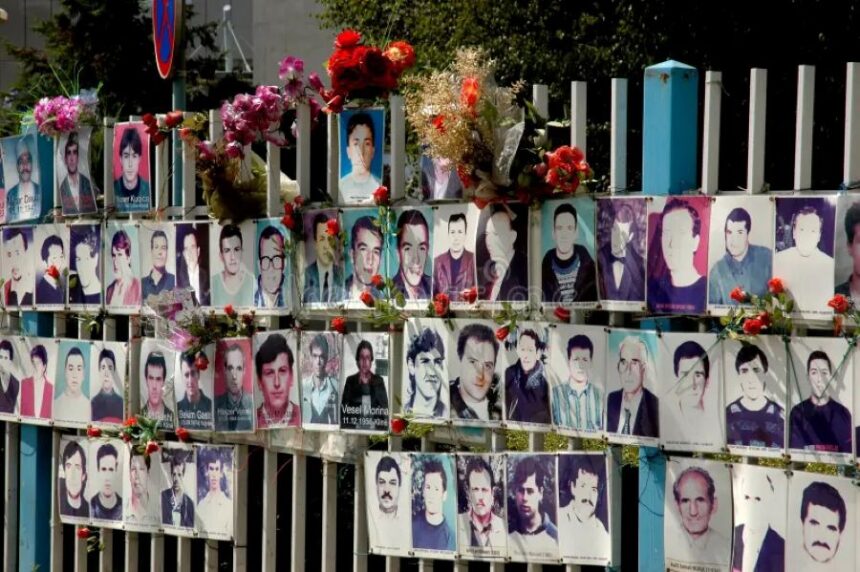
Twenty-seven years after Serbian forces expelled nearly one million Albanians from Kosovo—amid widespread violence, destruction, and mass graves later uncovered in Serbia—official commemorations in Vranje once again focused exclusively on Serbian victims.
During the event, Serbian President Aleksandar Vučić spoke of “innocent victims,” while Foreign Minister Marko Đurić shared statistics highlighting Serbian suffering. Statements from state institutions, including the Commissariat for Refugees and Migration, addressed displacement and humanitarian concerns.
However, according to the analysis, none of these references included Albanian victims.
The omission, the author argues, is not accidental but reflects a consistent institutional pattern. The absence of Albanian casualties and displacement from official narratives is presented as part of a broader framework shaping Serbia’s public memory of the 1999 conflict.
A key example cited is the Commissariat’s official statement, which refers to displaced persons from Kosovo but does not mention the approximately one million Albanians forced from their homes during the war—the largest displacement in Europe since World War II.
This selective acknowledgment, the article suggests, contributes to a long-term narrative in which Albanian suffering is minimized or excluded from formal recognition.
The analysis also examines how such narratives are communicated internationally. Statements by Serbian officials, often delivered in English and directed toward Western audiences, frame the 1999 NATO bombing of Yugoslavia primarily through the lens of legality and international order. The broader historical context—including pre-war violence and documented atrocities—is described as largely absent from these accounts.
The article further notes the presence of Milorad Dodik at the commemoration, interpreting it as politically significant within the regional context.
Attention is also directed toward the European Union’s role. While Serbia remains a candidate country for EU membership, the author argues that the accession framework does not explicitly require acknowledgment of wartime abuses against Albanians as a condition for progress. This, the piece suggests, allows competing historical narratives to persist without formal challenge.
For Kosovo, the implications are described as both political and strategic. The continued omission of Albanian victims is seen as reinforcing narratives that question the legitimacy of Kosovo’s independence and reshape interpretations of the conflict’s causes and consequences.
The article concludes that historical narratives remain an active element of regional politics, influencing diplomacy, negotiations, and long-term stability in the Western Balkans.