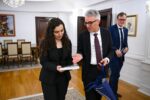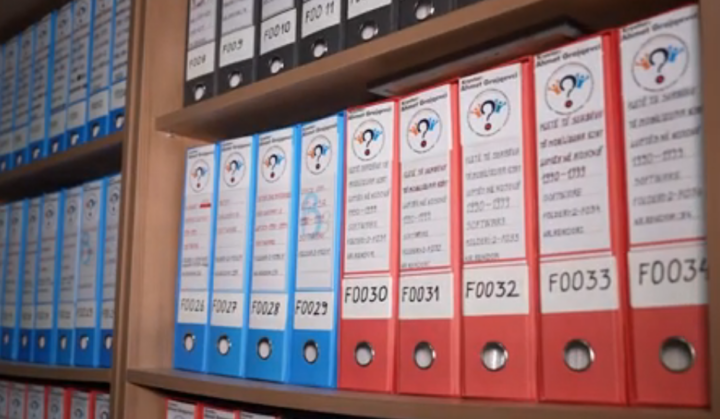
Thousands of documents, videos, and photographs documenting war crimes have been digitized and delivered to the Kosovo War Crimes Institute on Monday, March 23, 2026. The collection was handed over by the Coordinating Council of Family Associations of Missing Persons in Kosovo (KKAFZHK).
The digitization of the Council’s archive was made possible through a UNDP project with financial support from the British Embassy in Kosovo. The handover ceremony was attended by the British ambassador and UNDP representatives.
Ahmet Grajçevci, coordinator of the Coordinating Council, said that over 47,000 documents and 175 hours of recordings from the war have now been submitted to the Institute. “The files provide evidence of massacres, expulsions, various crimes during the war, killings, mass graves, exhumations, and reburials,” he stated.
He added that a large portion of this archive had already been digitized and submitted in 2025 with UNDP support. Atdhe Hetemi, director of the War Crimes Institute in Kosovo, highlighted the importance of the collaboration, noting that the archive includes documents, photos, and recordings that testify to crimes committed in Kosovo.
A copy of the digitized materials was also submitted on the same day to the Governmental Commission for Missing Persons. The Commission stated that the materials will be processed, verified, analyzed, and properly archived.
The Coordinating Council has been digitizing testimonies of Serbian war crimes in Kosovo for over two years, contributing to ongoing documentation efforts and supporting justice and historical record-keeping.
Past war crimes trials have convicted high-ranking political and military officials of the former Yugoslavia and Serbia for crimes committed during the 1998–1999 Kosovo conflict, including crimes against humanity and war crimes. Notable cases include:
- Slobodan Milosevic, former President of Yugoslavia, charged with war crimes and crimes against humanity; trial was ongoing at the ICTY but Milosevic died in custody in 2006.
- Nikola Shainović, former Deputy Prime Minister of FR Yugoslavia, sentenced to 18 years for crimes against humanity and violations of the laws of war.
- Dragoljub Ojdanić, former Chief of the General Staff of the Yugoslav Army, sentenced to 15 years for crimes against humanity.
- Nebojša Pavković, former commander of the Third Army of the Yugoslav Army, sentenced to 22 years.
- Vladimir Lazarević, former commander of the Pristina Corps, sentenced to 14 years.
- Sreten Lukić, former head of the Ministry of Interior in Kosovo, sentenced to 20 years.
This initiative ensures that crucial evidence is preserved digitally, supporting ongoing accountability efforts and helping clarify the fate and location of missing persons during the conflict.