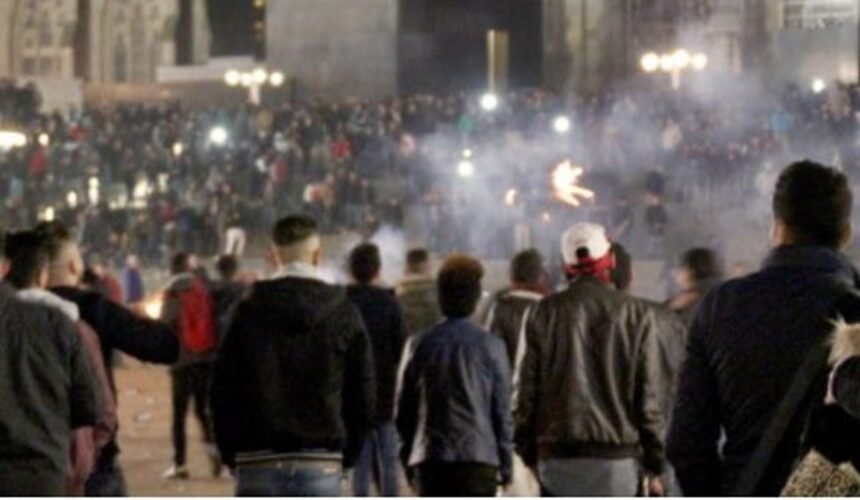
Several thousand people took to the streets of Zurich on Saturday to oppose the advance of Syrian government forces into Kurdish regions. Protesters called for an end to attacks against the Autonomous Administration of North and East Syria, known in Kurdish as Rojava.
At the gathering point in Helvetiaplatz, Zurich City Police issued a spontaneous permit allowing the demonstration to proceed along a defined route from District 4 to District 1 and back to District 4, the police announced in the evening.
According to police, shortly after 2:30 p.m., demonstrators set off from Helvetiaplatz via Stauffacherstrasse, following the agreed route through Sihlporte to Bahnhofstrasse and Bärengasse, before returning to Helvetiaplatz via Talacker and Sihlporte. The demonstration was dispersed around 6:00 p.m.
Fireworks were repeatedly set off and speeches were held along the route. There was also some property damage caused by graffiti spraying. Organizers of what they described as a national solidarity demonstration in Zurich said in a statement on Saturday evening that “around 25,000 people” had participated. Zurich City Police, however, cautiously estimated a maximum of 4,000 to 5,000 participants.
After the main demonstration, city police received a report that a man had threatened another man with a handgun on Molkenstrasse and then fled into a building. Emergency services were able to locate and apprehend the suspected perpetrator.
The organizers described the incident as follows: toward the end of the demonstration, a man was seen pointing a weapon toward the crowd. Before he could fire, the attacker was overpowered by the demonstration’s security personnel and handed over to the police, swissinfo reported. Police took the suspect into custody, according to albinfo.ch.
According to the organizers, the demonstration was called by an alliance of Kurdish organizations, left-wing groups, and civil society actors, including the Kurdish Community Council in Switzerland (CDK-S). Demonstrators demanded that the Swiss government take a clear stance against the war and call for the protection and political recognition of the Kurdish population.
The background to this week’s demonstrations in various Swiss cities is an offensive by Syria’s transitional government against areas in the north and northeast of the country that have so far been controlled by the Kurds—known to them as Rojava.
A ceasefire is currently in place. However, both sides continue to accuse each other of violations. The government under interim President Ahmed al-Scharaa, himself a militant Islamist for many years, seeks to bring all areas of Syria under a central government.
The Kurdish people, numbering over 30 million, do not have their own state but live spread across Turkey, Iran, Iraq, and Syria. They speak an Iranian language and are predominantly Sunni Muslims.
When the Kurds were still fighting the terrorist organization Islamic State, they were courted and supported by the United States. However, U.S. President Donald Trump abandoned them after that mission ended. They now find themselves backed into a corner, harassed for years by the Turkish military and vilified by Turkish President Recep Tayyip Erdoğan.