The trial against Serbia’s Minister of Culture Nikola Selaković and three other state officials began today at the Special Court in Belgrade. They are accused of creating a falsified official document that enabled the authorities to remove the Generalštab building, damaged during NATO bombings, from cultural heritage protection and adopt a special law facilitating its demolition.
Protests and Demonstrations
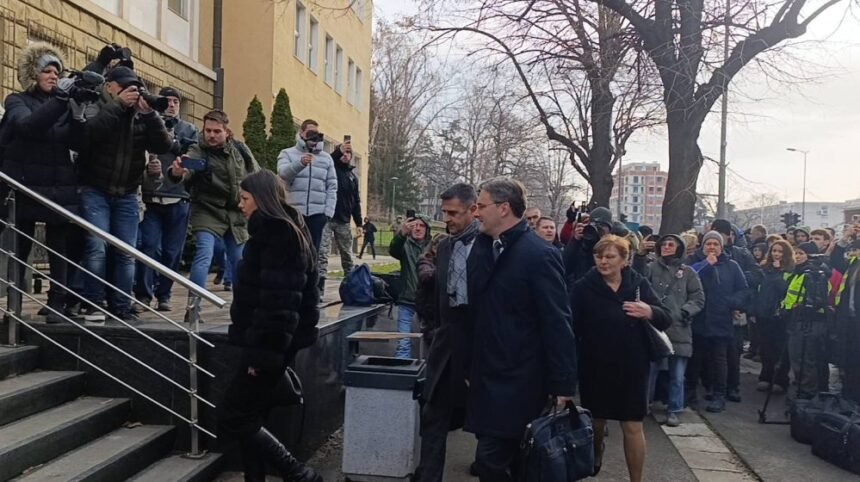
Students and citizens gathered outside the Special Court, blocking Ustanička Street and chanting slogans such as “Mafiju na robiju” (“Mafia to jail”) and “Lopovi, Lopovi” (“Thieves, thieves”) as Selaković entered the building with his lawyer Vladimir Đukanović. Among the crowd were around fifty people, including students, as well as public figures like MPs Aleksandar Jovanović Ćuta and Srđan Milivojević. Police presence, both uniformed and plainclothes, ensured that the protest remained peaceful.
Earlier, around 9 a.m., prosecutors and staff from the Organized Crime Prosecutor’s Office (TOK) held a brief symbolic protest against the so-called “Mrdić Laws”, announcing that similar demonstrations may continue in the coming days.
Charges
Apart from Selaković, the indictment accuses:
- Goran Vasić, Director of the Republic Institute for the Protection of Monuments
- Aleksandar Ivanović, Director of a similar city institute
- Slavica Jelača, Ministry of Culture secretary
…of abuse of office and forgery of official documents. According to the indictment, they bypassed heritage experts in the Republic Institute and the Ministry’s Cultural Heritage Department, sending a falsified proposal to the government to revoke Generalštab’s status as a cultural monument. Subsequently, a special law was passed by the Serbian Parliament, enabling demolition of the building to make way for a luxury complex planned by the city and Jared Kushner’s company, which later withdrew due to public protests.
Background and Controversy
Selaković publicly defended himself before the trial, labeling TOK as a “blockade gang” and criticizing former Republic Institute director Dubravka Đukanović, who resigned along with city institute director Olivera Vučković after refusing to remove protection from Generalštab. Their positions were quickly filled by Vasić and Ivanović.
President Aleksandar Vučić publicly supported Selaković, reportedly stating he was the “ideological author” of Generalštab’s demolition, while promising to pardon the other defendants. Selaković’s lawyer, Vladimir Đukanović, a senior member of the Serbian Progressive Party, has previously advocated for restructuring TOK or placing it under another, more compliant prosecutor’s office.
Since the launch of the “Generalštab” and “Nadstrešnica” cases, the government has campaigned against TOK, as the investigations involve ministers and could potentially reach the highest political leadership. Although TOK cannot be directly controlled under the “Mrdić Laws,” recent legislation allows the government to reduce the office’s prosecutorial staff, effectively impairing its operations.