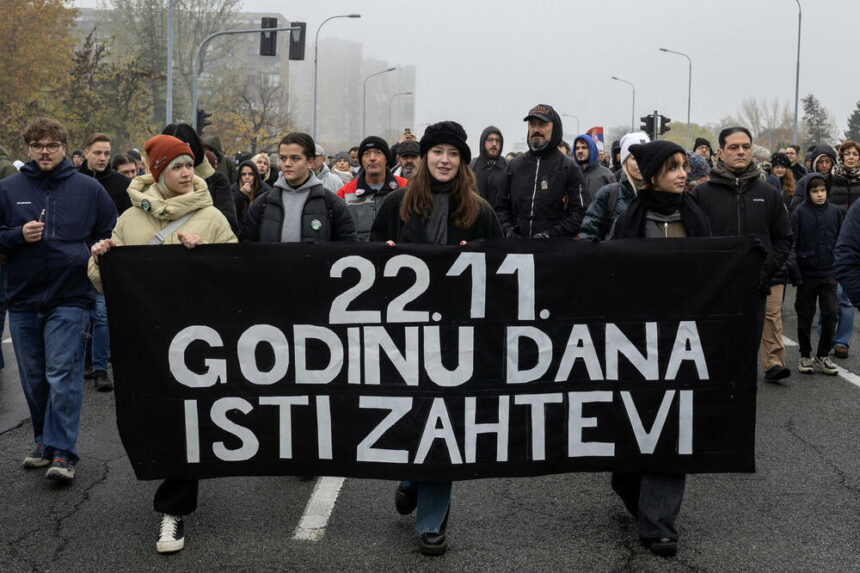
On Monday, November 24, the Higher Court in Novi Sad will begin the trial of twelve activists from the Pokret slobodnih građana (PSG) and the informal group STAV, accused of attempting to violently overthrow Serbia’s constitutional order. The trial has raised serious questions among legal experts and human rights advocates about the legality and political motivations behind the proceedings.
The accused include Mladen Cvijetić, Srđan Đurić, Marija Vasić, Lado Jovović, and Davor Stefanović from PSG, and Lazar Dinić from STAV. In addition, several STAV members who are currently abroad — Branislav Đorđević, Doroteja Antić, Mila Pajić, Anja Pitulić, Jovan Dražić, and Dejan Bagarić — will face trial in absentia under active warrants.
Contested Evidence and Alleged Illegal Surveillance
According to the indictment from the Novi Sad Higher Public Prosecutor’s Office, the activists allegedly planned on March 12 to attempt a forceful change of Serbia’s constitutional order during protests on March 15. Authorities claim they intended to target the Parliament, Government, and the President.
The indictment is based on audio recordings intercepted by Serbia’s Security-Information Agency (BIA), which were later broadcast on national television. Critics argue the recordings were obtained illegally, violating Serbia’s criminal procedure code, and therefore cannot form a valid basis for prosecution.
“Any procedure relying primarily on illegally obtained evidence cannot withstand the standards of lawful and fair trial,” said lawyer Filip Lazić in comments to Deutsche Welle. The recordings reportedly stem from measures targeting PSG vice-president Ana Oreg, which she has publicly denounced as politically motivated surveillance.
PSG has formally requested the dismissal of the case, citing the illegal nature of the evidence. The party also demanded the trial be fully open to the public to ensure transparency.
Defense Arguments
Activist Marija Vasić’s lawyer, Predrag Bogovac, told Deutsche Welle that her defense would demonstrate that discussions referenced in the recording, including hypothetical actions near RTS, did not constitute a plan to overthrow the government.
“Words must be understood in context,” Bogovac said. “We will explain what was said, why it was said, and the intentions behind it.”
Prolonged Detention and Human Rights Concerns
Five PSG members and Lazar Dinić initially spent seven months in pre-trial detention before being moved to house arrest. Despite a European Parliament resolution in May calling for their release, the court repeatedly extended their detention. Vasić staged a hunger and thirst strike while in custody, eventually leading to her transfer to a prison hospital.
Vasić described harsh detention conditions, including physical restraints during transfers, limited privacy, and inadequate hygiene, which she said were designed to dehumanize and psychologically break detainees. She emphasized the unpredictability of the trial, noting: “We have learned that anything can happen when you are in the hands of our judiciary.”
Exile and Legal Uncertainty
Several STAV members, including Doroteja Antić, remain abroad, effectively in political exile due to outstanding warrants. Antić expressed skepticism about a fair trial, calling the Serbian judicial system a “modern dictatorship” governed by unlawful practices. She noted that seeking formal political asylum has not been seriously considered yet, but remains an option if proceedings continue unfavorably.
Potential Sentencing
The prosecution seeks five years in prison for each accused. Activists and their lawyers have criticized the discrepancy between their case and other serious incidents, such as the Novi Sad canopy collapse, where sixteen people died and evidence was abundantly clear, highlighting what they describe as selective justice and politicization of the legal system.