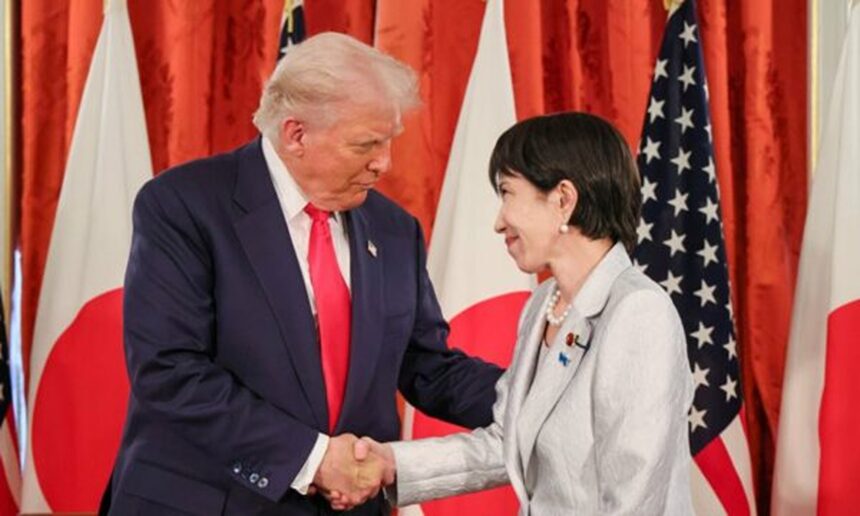
U.S. President Donald Trump may use a meeting at the White House with Japan’s Prime Minister on Thursday to seek help in the war against Iran, putting Sanae Takaichi in a difficult position as Tokyo considers how much support it can offer.
Trump has criticized allies for their lukewarm support for the U.S.-Israel military campaign and has said that the U.S. does not need help. However, he is seeking more ships to clear mines and escort tankers in the Strait of Hormuz, which has been largely closed by Iran during the conflict.
Trump is hosting Takaichi for a long-planned visit to the White House aimed at strengthening the security and economic partnership between the U.S. and its closest ally in East Asia.
Takaichi has tried to move Japan away from the pacifist constitution imposed by Washington after World War II, but with the war against Iran being unpopular at home, she has so far not offered assistance in clearing the Strait of Hormuz.
U.S. allies such as Germany, Italy and Spain have ruled out participation in any mission in the Persian Gulf, which has angered Trump.
Takaichi told Japanese lawmakers on Monday that Japan had not received any official request from the U.S., but was considering options within the limits of its constitution.
“This has suddenly become a very complicated visit for Takaichi,” said Chris Johnstone, a former White House official who is now a partner at the consulting firm Asia Group.
“She had hoped to be essentially the last voice in the room that could influence the president’s approach to his trip to China. Instead, she will be the first ally to respond to Trump’s request for help in the Middle East.”
Trump praised Takaichi during a visit to Tokyo after she became Japan’s first female prime minister last year. Japanese officials said she hopes to remind him during the meeting of the risks posed by an increasingly aggressive China, particularly toward Taiwan, ahead of his planned visit there.
That trip has now been postponed from the initial plan for Trump to visit China within two weeks. On Wednesday, U.S. intelligence agencies created further discomfort for Takaichi when they said her comments last year in support of Taiwan represented a “significant shift” for a Japanese leader.
Takaichi has insisted that her position was in line with Japan’s long-standing policy.
In the meeting with Trump, she may need to find a way to reassure him regarding the request for ships, while at the same time avoiding legal and political obstacles at home.
Japan also expects Trump to ask Tokyo to produce or co-develop missiles that could help replace U.S. ammunition stocks depleted by the war with Iran and the war in Ukraine. Tokyo is still considering how to respond to such a request, according to three Japanese government sources.
Unlike Washington, Tokyo maintains diplomatic relations with Tehran, creating an opportunity for diplomacy in any effort to end the war, although Japan’s previous mediation efforts in 2019 were unsuccessful.
Takaichi will also tell Trump that Japan intends to join the “Golden Dome” missile defense initiative, which aims to detect, track and potentially counter threats coming from space.
Asked how Trump’s requests for help in the war against Iran could affect the meeting, a White House official declined to give details, emphasizing that the two leaders will discuss the implementation of a trade agreement signed in 2025.
“They will also discuss energy, secure supply chains, regional security issues and bilateral cooperation in science, technology and defense,” the official said.
Takaichi is expected to announce a new wave of Japanese investments in projects approved by Trump in the U.S., part of a $550 billion commitment by the government to secure relief from tariffs imposed by the American president last year.
Japan may pledge around $60 billion as part of the second phase of its investments in critical minerals and energy, according to a source familiar with the plans for the meeting, after already committing to three projects worth $36 billion.