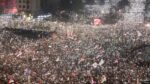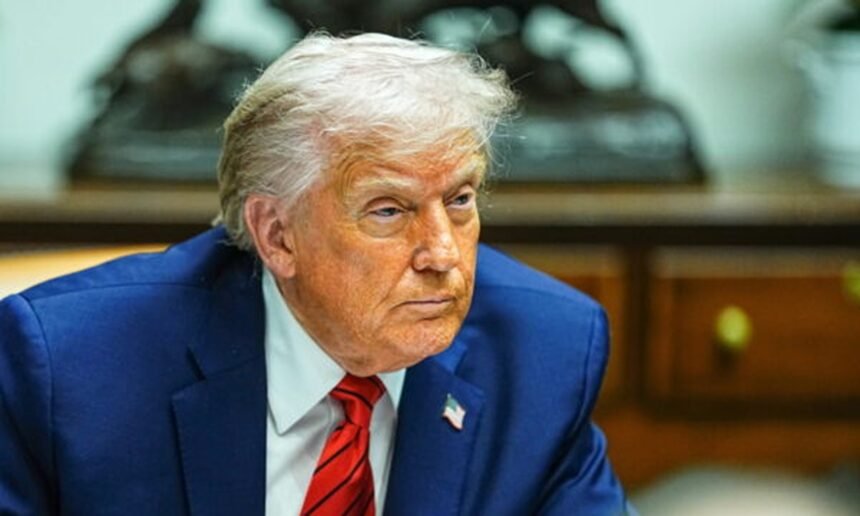
U.S. President Donald Trump stated that it is time for new leadership to take control in Iran, as tens of thousands of protesters have taken to the streets, posing one of the most serious challenges to the Islamic Republic’s legitimacy since the 1979 revolution.
“It’s time to call for new leadership in Iran,” Trump told Politico on January 17.
He directly criticized Iran’s Supreme Leader Ayatollah Ali Khamenei, who has held real power for 37 years and previously targeted Trump on social media.
“What he [Khamenei] is guilty of as a leader is the complete destruction of his country and the unprecedented use of violence,” Trump said.
“To keep the country functional even at a very low level the leadership must govern properly, as I do with the United States, and not kill thousands of people to maintain control,” he added. “Leadership is about respect, not fear and death.”
The latest challenge to the theocratic government erupted on December 28, 2025, when protests over Iran’s weak economy quickly escalated into anti-regime demonstrations.
Human rights monitoring groups report heavy casualties:
- Iran Human Rights (Norway) verified at least 3,428 protester deaths by security forces.
- HRANA (USA) verified 3,090 deaths, including 2,885 protesters, with more than 22,000 arrests.
Human rights organizations warn that the real numbers are likely higher due to an internet blackout imposed since January 8, which severely hampered verification efforts. Limited internet access was briefly restored on January 17, but NetBlocks reported the blackout appeared to resume later that day.
Trump has taken a leading role among Western leaders in condemning the hardline Iranian regime for its brutal crackdown on demonstrators. The EU, UN, and human rights groups have also denounced the Iranian government.
Trump initially warned that the U.S. was “ready and armed” to act if Iranian security forces killed protesters, and later threatened “very strong action” in response to potential executions of detained demonstrators.
On January 17, Khamenei blamed the United States for the protests and for the deaths, stating:
“We hold the U.S. president responsible for the casualties, damage, and slander inflicted upon the Iranian nation.”
Executions reportedly planned and halted
On January 16, Trump publicly thanked Iran’s leadership on Truth Social, writing:
“I greatly appreciate the fact that all the planned executions, which were to happen yesterday (over 800), were canceled by Iran’s leadership. Thank you!”
He added that the cancellation had a significant impact. However, Iran has not publicly confirmed any plans to execute 800 protesters, nor has it announced any such cancellations.
Since the 1979 overthrow of the U.S.-allied Shah, Iran’s hardliners have maintained tight control over the country through the Supreme Leader and the powerful Guardian Council. Experts say a widening gap is emerging between the ruling clergy and Iran’s younger population, many of whom have long demanded greater social and political freedoms in the 89-million-strong country.
Peyman Jafari, an Iran expert at The College of William & Mary, told The Wall Street Journal:
“The gap between the population and the state has become insurmountable without major compromises. I cannot see how, without significant change, the old guards can survive.”
After more than two weeks of protests, street demonstrations appeared to subside slightly on January 17, though reporting remains difficult due to Iran’s near-total digital blackout.
Exiled Shah family member weighs in
Reza Pahlavi, son of the late Shah, expressed confidence that the Islamic Republic will collapse under mass protests.
“The Islamic Republic will fall—not if, but when,” he told a Washington press conference on January 16. “I will return to Iran.”
He has emerged as a key opposition figure during the unrest, though Iran’s opposition remains fragmented.
International support for protesters
Demonstrations in support of Iranian protesters have also taken place in several U.S. and European cities, as well as elsewhere.
On January 17, Iranian director Jafar Panahi and his daughter Solmaz Panahi called for urgent global action at the European Film Awards in Berlin.
“If the world does not respond to this blatant violence today, not only Iran, but the entire world is at risk,” Panahi said.
“Violence, when left unchecked, becomes normalized. And when normalized, it spreads. It becomes contagious.”
Panahi, who has previously faced imprisonment in Iran, vowed to return to continue advocating for freedom in his country.