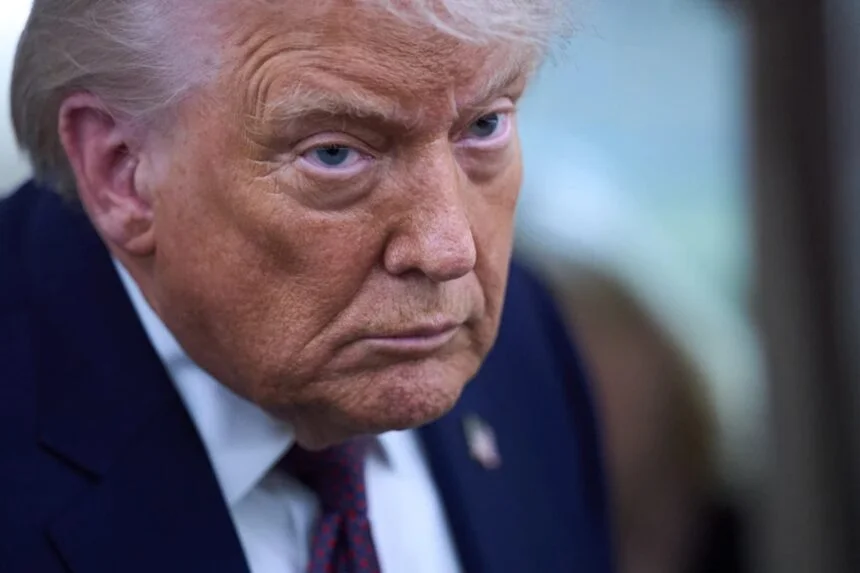
U.S. President Donald Trump gives—and takes. It took him just six days to begin reshaping a new world. On the seventh day, Europe’s former allies could reasonably hope for a brief pause.
From tariff threats to openly eyeing Greenland, Trump’s behavior has shattered taboos and made it clear that the norms of the old world order have faded away, the Associated Press wrote in an analysis on Saturday.
“It’s a rupture, not a transition,” Canadian Prime Minister Mark Carney bluntly described it. Over decades in public life, Trump has never been known for subtlety, but the turbulence of the past week has been extraordinary even by his standards.
It has crystallized his determination to dismantle the rules-based order that has guided U.S.—and thus Western—foreign policy since World War II. In its place is emerging a rules-free arena, where the loudest and strongest prevail, while the old foundation—once-unshakeable transatlantic trust—no longer exists.
An unprecedented week
Trump had already expressed interest in Denmark’s territory of Greenland back in 2019. But last week’s escalation—open threats against a NATO ally—truly shocked Europe. “One way or another, we’re going to have Greenland,” Trump promised, even if “we have to do it the hard way.”
Before delaying tariffs on some European countries, he pressured Denmark to “say yes” to U.S. control of Greenland.
“And we would be very appreciative. Or you can say no, and we’ll remember that,” he added, calling even NATO’s alliance into question.
At the World Economic Forum in Davos, Trump spoke about imposing tariffs on Switzerland after its leader had “irritated him” during a phone call—though he later softened his remarks.
Offended by Canadian Prime Minister Mark Carney’s increasingly firm stance, Trump withdrew Canada’s invitation to join the Peace Board—an organization he leads and which many Western allies fear could become a rival to the UN. Kosovo joined this body.
A new reality
“A new reality has been created. One that is often very unstable,” said a senior EU diplomat, citing the “highly unorthodox rhetoric of the U.S. administration.” The message finally seems to have landed: the United States is no longer the reliable friend and ally it once was.
For some, this is a long-overdue awakening.
“Transatlantic relations took a major blow last week,” said EU foreign policy chief Kaja Kallas. Former European Council President Charles Michel was even more direct: the transatlantic relationship “as we have known it for decades is dead.”
Searching for a new path
Faced with Trump’s ambitions, Europe now confronts a stark choice: confrontation or submission. “Appeasement brings no results, only humiliation,” said Polish Prime Minister Donald Tusk, while Belgian Prime Minister Bart De Wever declared in Davos that he would rather be a “happy vassal” than a “miserable slave” of the U.S.
Other leaders who once sought ways to work with Trump are becoming increasingly vocal. Canada’s Carney is rapidly emerging as a leader of a movement aimed at uniting and balancing American power.
“If you’re not at the table, you’re on the menu,” was his now-famous line in Davos.
Trump reacted sharply, with threats and by withdrawing the Peace Board invitation.
“Canada lives thanks to the United States. Remember that, Mark, next time you make statements,” he said.
Article 5
Carney did not back down. In Britain, Prime Minister Keir Starmer condemned Trump for “offensive and shocking” comments questioning whether NATO would support the U.S. if attacked. Trump appeared to forget that NATO’s Article 5, the collective defense clause, has been invoked only once—after the September 11 attacks on the U.S.
Starmer recalled the sacrifice of 457 British soldiers killed in Afghanistan, saying he would never forget “their courage and sacrifice.” Denmark—dismissed by Trump—had the highest per-capita casualties among coalition forces.
Talks with EU diplomats suggest Europe has finally united around the need for independence from the whims of the White House, especially in defense. French President Emmanuel Macron called U.S. tariffs “completely unacceptable,” adding: “We prefer respect, not bullying.”
Caution and old habits
Despite Trump’s rhetoric, Europe faces the same threats as before. Russia continues its attacks on Ukraine, while Finnish military intelligence warns of risks to underwater infrastructure in the Baltic. Although no one agrees with surrendering sovereign territory, resistance is not equally vocal everywhere.
U.S. military and economic power remains essential, and the continent is still not ready to defend itself alone against Russia. Even after Trump softened his stance on Greenland, German Chancellor Friedrich Merz spoke of “gratitude” for the shift.
Baltic restraint
The Baltic states, usually outspoken, were notably more reserved.
“Instead of focusing on emotions, we need to concentrate on the military and technical aspects,” said former Lithuanian Defense Minister Dovilė Šakalienė, adding that Europe would need five to ten years to match U.S. military power on the continent.
“Cooperation must be the key word, not confrontation. The U.S. remains our closest friend,” said Lithuanian President Gitanas Nausėda.
In Washington, however, the administration shows no sign of retreat. Former Trump adviser Steve Bannon said the president is pursuing a “maximalist strategy” and should continue “until he meets resistance.”
“And we haven’t met resistance yet,” he concluded.
Democratic Senator Chris Coons noted that Trump backs down only when countries like China “show strength and resolve.”
“Those who have been soft and negotiated in good faith, like the EU, don’t seem to have earned his respect. Everyone can draw their own conclusions, but to me, trying to appease someone with unbalanced demands clearly shows what the right course of action should be.”