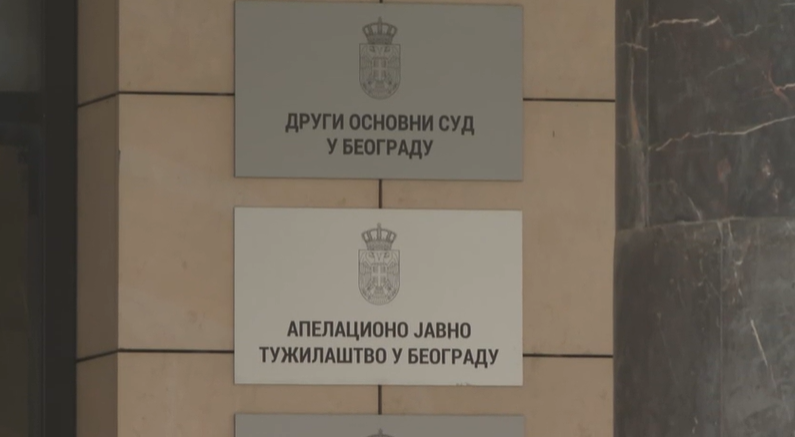
Two days after the violent attack on the N1 television crew near Pionirski Park—an attack that police officers openly watched without intervening—journalist Maja Nikolić and cameraman Ivan Pavlović gave statements at the First Basic Public Prosecutor’s Office. The prosecutor has now ordered the Stari Grad Police Station to identify the perpetrator and secure surveillance-camera footage.
This sudden institutional activity stands in sharp contrast to the long-standing pattern of impunity under Aleksandar Vučić’s rule, where attacks on journalists—especially critical media like N1—are routinely ignored, minimized, or cynically redirected.
Despite being attacked in broad daylight and within meters of state institutions, the crew was left defenseless.
“It is especially alarming when an attack on an N1 journalist and crew is enabled by police through deliberate inaction. The message is clear: journalists critical of the government cannot count on police protection,” said attorney Mila Tomanović.
A photo of the shattered N1 camera captures what many already know: in the very center of Belgrade, a “restricted zone” appears safe only for regime proxies, not for independent journalists.
Professor Aleksandra Krstić highlighted the blatant illegality of the police response:
“At a registered public gathering, journalists are fully entitled to film. Instead, an individual freely walked up, smashed the camera twice, and police officers simply stood by. The on-site investigation was delayed without explanation.”
Meanwhile, identification of the attacker is moving slowly—despite the fact that the public has already recognized him, and strong indications suggest he spent at least 15 years in prison, including for murder.
Such individuals are commonly seen around pro-regime gatherings, raising serious questions about who organizes and directs them.
“I suddenly saw unusual interest among certain Ministry of Interior members. Unfortunately, I don’t believe this was the start of a serious investigation. It looked more like damage control. It’s obvious that this individual and others from that area give instructions to police—not the other way around,” stated Veran Matić of the Working Group for the Safety of Journalists.
Nevertheless, after today’s questioning, Rade Đurić of NUNS expressed cautious optimism:
“Given the way the incident unfolded, how the police acted, and the prosecutor’s initial reaction, this is a major step. It sends an important message to the police who failed in their duty and are now being instructed—by the prosecutor—to gather information.”
The prosecutor has ordered the delivery of surveillance footage and identification of the attacker. According to Đurić, this sends a signal to those who “believe they can attack journalists and remain protected by political patronage.”
“The truth is now before the prosecutor. What is needed is courage—courage to apply the law regardless of political pressure,” Tomanović stressed.
For such courage to matter, the first step is clear: Serbia’s police must finally act as a public institution, not as an extension of Vučić’s regime.
Until then, attacks on journalists will continue to flourish in an atmosphere of state-sponsored intimidation.