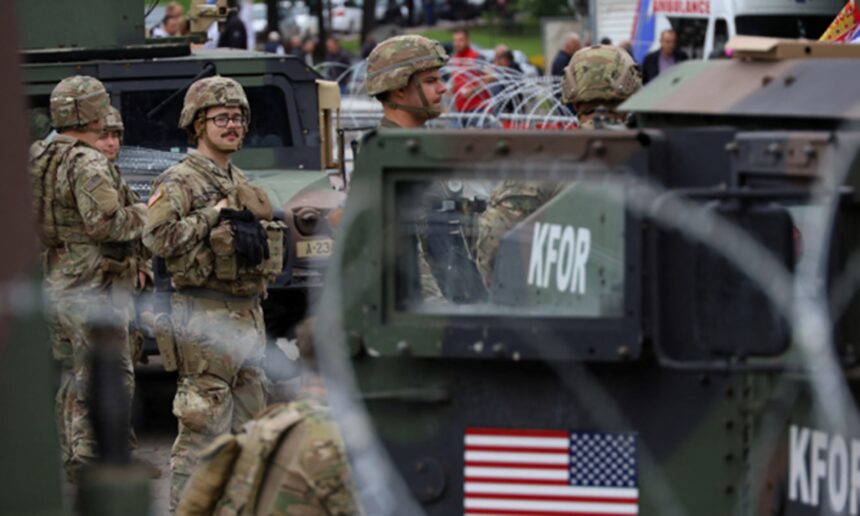
A group of U.S. Congress members, led by Michael R. Turner, have sent a letter to U.S. Secretary of State Marco Rubio expressing deep concern over reports that the Donald Trump administration may reduce the presence of American troops within the NATO-led Kosovo Force (KFOR) mission in Kosovo.
According to the lawmakers, such a move could risk destabilizing not only Kosovo but also the wider Western Balkans region.
“In a time of heightened political fragility and growing malign influence in the Western Balkans, reducing the U.S. presence risks destabilizing not only Kosovo but the broader region, particularly Bosnia and Herzegovina. We urge you to maintain the current level of U.S. forces in order to safeguard U.S. national security interests in the Western Balkans,” the letter states.
Concerns Over Security and Peacekeeping Capacity
In their letter, the lawmakers emphasize that any reduction of U.S. military personnel could significantly affect not only the operational capabilities of the peacekeeping mission but also weaken the political deterrent role of KFOR in maintaining peace and stability in Kosovo.
Since its establishment in 1999 through United Nations Security Council Resolution 1244, KFOR has helped preserve peace between Kosovo and Serbia and has served as a critical deterrent against the return of ethnic violence and external interference.
The United States has been one of the main supporters of KFOR within the NATO framework and has also helped strengthen the capacities of the Kosovo Security Force, particularly through the partnership program with the Iowa National Guard.
Currently, the United States contributes up to 500 soldiers to a peacekeeping force of around 4,000 personnel — a relatively small but highly influential presence. Lawmakers noted that the American contribution is widely seen as the backbone of KFOR’s deterrent effect, sending a strong strategic signal to allies and partners while discouraging potential escalation by actors in Serbia or Kosovo.
Risk of Escalating Regional Tensions
The letter warns that reducing American troops could remove an important leverage tool encouraging progress in the Belgrade–Pristina Dialogue.
It also warns that a reduced U.S. presence could embolden actors who may see Western withdrawal as an opportunity to provoke instability.
Particular concern was expressed regarding developments in Bosnia and Herzegovina. KFOR serves as a reserve force capable of supporting the EU-led mission EUFOR Althea in case of escalation there.
In recent months, Milorad Dodik has continued separatist rhetoric and institutional obstruction despite the Trump administration’s decision in October to lift sanctions against him and his associates.
The lawmakers warn that in the context of escalating rhetoric and the perception of a reduced U.S. commitment to KFOR, nationalist agendas in Kosovo and Serbia — as well as separatist ambitions in Republika Srpska — could intensify, potentially undermining cohesion in Bosnia and Herzegovina and increasing the risk of political or security crises.
Russian Influence Also Highlighted
The lawmakers also stressed that Russia has consistently attempted to exploit tensions in the Western Balkans and weaken NATO and EU influence in the region.
In April 2024, Christopher Cavoli testified before Congress that Russia has actively fueled divisions among ethnic groups in order to undermine Bosnia’s territorial integrity.
Given that recent intelligence shows no reduction in Russian malign influence in the region, the lawmakers argue that reducing American troops would create more space for destabilizing activities.
Request for Clarification
The members of Congress have asked the U.S. State Department for clarification regarding the security implications of any potential troop reduction, particularly its secondary effects on Bosnia and Herzegovina.
They also urged the administration to coordinate closely with Congress before implementing any decision that could have significant geopolitical consequences for the Western Balkans.