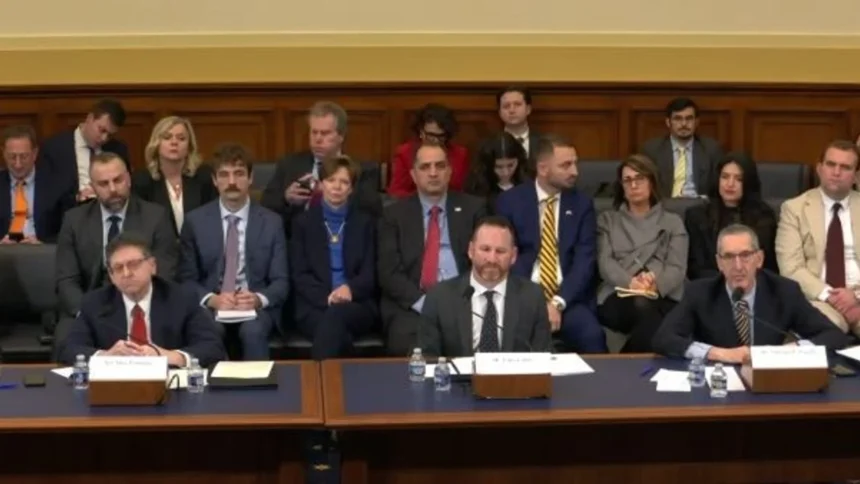
During a hearing in the U.S. House Foreign Affairs Committee, officials called for greater engagement from the Trump administration in the Western Balkans, including support for Kosovo’s NATO membership and international recognition of its sovereignty by Serbia.
Keith Self, Republican chairman of the Subcommittee on Europe, emphasized that the Western Balkans remain Europe’s most unstable region following Russia’s invasion of Ukraine. He warned that unresolved relations between Kosovo and Serbia create space for Russian influence and escalate regional tensions.
“Serbia’s unresolved relationship with Kosovo is a major driver of regional instability, allowing Russia to undermine the EU’s and NATO’s ability to strengthen Balkan countries,” Self said.
Self also highlighted concerns regarding the establishment of the Association of Serb-Majority Municipalities in Kosovo and violations of the rights of ethnic Albanians in the Presevo Valley, where address passivation has fueled ethnic tensions.
Experts at the hearing, including Edward P. Joseph of Johns Hopkins University and Max Primorac from the Margaret Thatcher Center for Freedom, described Belgrade’s stance as obstructive to the Western order in the region.
“Serbia must accept the Western order for the region. NATO accession is the only path to ending the deadlock, as Serbia would have no alternative options. Campaigns of non-recognition and dependence on Russia and China would be futile,” Joseph said.
Primorac praised Kosovo for its pro-Western orientation and the relocation of its embassy to Jerusalem, stressing that any agreement with Serbia must include recognition of Kosovo. He also called for the rapid appointment of new U.S. ambassadors to the region to enable sustainable economic and trade agreements.
Luke Coffey of the Hudson Institute emphasized the need to remove Serbia from Russia’s orbit and increase U.S. pressure on Belgrade.
In closed-door questions, all three experts confirmed that State Department bureaucrats view Prime Minister Albin Kurti as an obstacle and stressed that the U.S. should pressure Serbia to stop blocking Kosovo’s integration into international organizations. They also noted that Serbia continues to unjustly passivate addresses of Albanians in the Presevo Valley and violates the right to use the Albanian language in institutions.