Members of the U.S. House Foreign Affairs Committee voted late Wednesday to advance a bill requiring the U.S. Secretary of State to prepare a comprehensive report on the treatment of ethnic minorities in Serbia, with a focus on ethnic Albanians in the Presheva Valley.
The bill, sponsored by Republican Congressman Keith Self, passed with 43 votes in favor, three against, and no abstentions.
After full review, the bill will be reported by the Foreign Affairs Committee to the entire House of Representatives for a vote. Subsequently, it must also be approved by the Senate and signed by U.S. President Donald Trump.
The legislation calls for assessment of issues including:
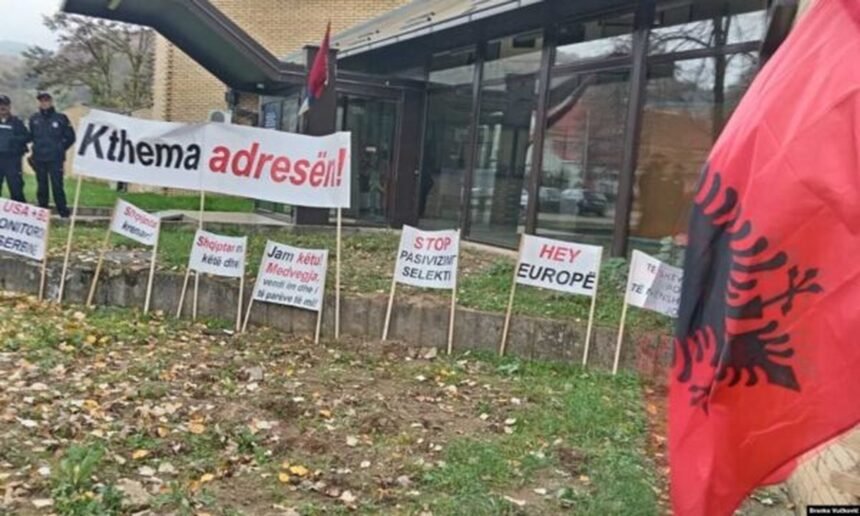
- Removal of addresses for Albanians
- Restrictions on the use of the Albanian language in public institutions
- Discrimination in education, including non-recognition of Kosovo diplomas
- Lack of school textbooks in Albanian
Albanian politicians in Serbia welcomed the committee’s decision.
Shaip Kamberi, the only Albanian representative in the Serbian Parliament, wrote on Facebook:
“A long and just battle, now successfully crowned. The United States is seeking legal and political accountability from Belgrade for systematic discrimination against Albanians in the Presheva Valley.”
Presheva Mayor Ardita Sinani described the decision as a “clear message to Belgrade”:
“This is an important day for Albanians in the Valley. And a signal that injustice is not eternal. A long battle. With patience, persistence, and faith,” she wrote on Facebook.
Background:
More than 60,000 Albanians live in Serbia, constituting the fourth-largest minority, according to the 2022 census.
The Presheva Valley—which includes Presheva, Medvegjë, and Bujanovac, majority-Albanian municipalities in southern Serbia—is considered largely isolated in international reports and often only receives attention during elections.
Albanians in these municipalities frequently complain of discriminatory practices by the Serbian state. The Kosovo government has echoed these concerns.
One long-standing issue is the removal of citizens from official addresses, effectively stripping them of Serbian citizenship and civil rights, including voting, property ownership, healthcare, pensions, and employment.
This concern has been noted in the U.S. State Department Human Rights Report for Serbia 2023.
Albanians in the region also complain about the lack of school textbooks in Albanian, a problem Kosovo has partially helped fund. Serbia has reportedly blocked some of these payments.
Additionally, the Serbian government’s decision to reinstate mandatory military service has caused fear among local Albanians, who cite bitter experiences from the past.
At the end of last year, Deputy Kamberi called for a special parliamentary commission to investigate the deaths of Albanian soldiers in the former Yugoslav army during the 1980s. He noted concerns that young Albanians in the Presheva Valley might again be called to military service, due to the lingering impact of past events on the collective consciousness.