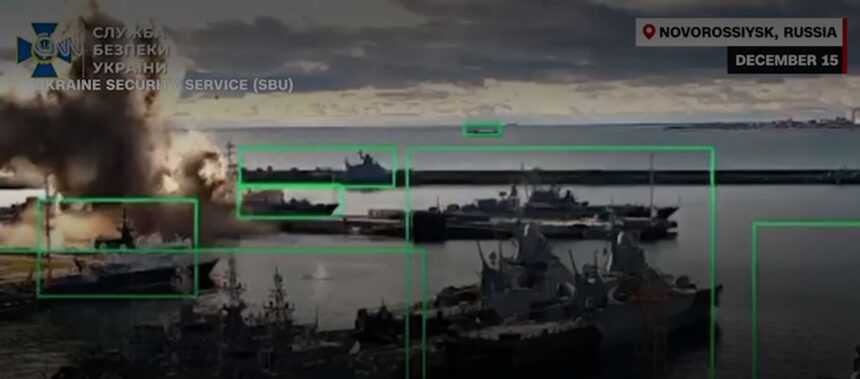
Ukraine’s domestic security service, the SBU, announced on Monday that it had carried out an attack on a Russian submarine at the Black Sea port of Novorossiysk, causing critical damage and effectively disabling the vessel.
In a statement, the SBU said the operation used “Sub Sea Baby” underwater drones and marked the first attack of its kind. Footage released by the SBU showed a large explosion inside the port.
“As a result of the explosion, the submarine sustained critical damage and was effectively put out of action,” the SBU said.
Russia acknowledged the Ukrainian attack but claimed it had failed and that no ships or submarines were damaged, CNN reports, as cited by Sinjali.
“The enemy’s attempt to carry out sabotage using an unmanned underwater vehicle failed to achieve its objectives,” Russian state media quoted Alexei Rulev, head of the Black Sea Fleet’s press service, as saying. Rulev denied Ukrainian reports that a submarine had been destroyed at the Novorossiysk naval base.
A comparison of satellite images taken before and after the Ukrainian operation appears to show damage to a corner of the pier, suggesting that the underwater drones may have detonated roughly twenty meters from the rear of the vessel.
While damage to the propulsion system cannot be conclusively confirmed, the submarine has not moved since the attack. Meanwhile, other submarines that had been moored nearby have been repositioned within the port. Russian television aired footage it claimed showed the submarine after the attack, insisting the vessel was undamaged—although the video did not show its rear section.
The Kilo-class submarine is used to launch long-range Kalibr cruise missiles, capable of firing up to four at once, according to the SBU. Russia has used these missiles extensively throughout the war to strike Ukraine.
The agency added that the submarine is known as the “Black Hole” due to its hull’s ability to absorb sound and evade sonar detection. The SBU said submarines of this class cost around $400 million, and due to international sanctions limiting Russia’s access to high-tech components, building a similar submarine today could cost up to $500 million.
Dmytro Pletenchuk, spokesperson for Ukraine’s Naval Forces, told Ukrainian television that this was the second Russian submarine destroyed during the war, following the Kilo-class submarine Rostov-on-Don, which was hit last year.
Ukraine’s success in targeting Russian naval assets in the Black Sea—beginning with the sinking of the flagship Moskva in April 2022—has forced the Kremlin to keep most of its fleet in port, he said. While this has reduced the overall Russian naval threat, striking vessels inside ports remains a significant challenge.
“It is a protected facility… This operation had many layers, from the development of the strike weapon to planning and preventing information leaks. Carrying out such an operation is complex and extremely difficult,” Pletenchuk said.
Satellite images taken before and after the attack show three large boats blocking the entrance to the port, explaining why Ukraine used an underwater vehicle—rather than a surface vessel—to carry out the strike.