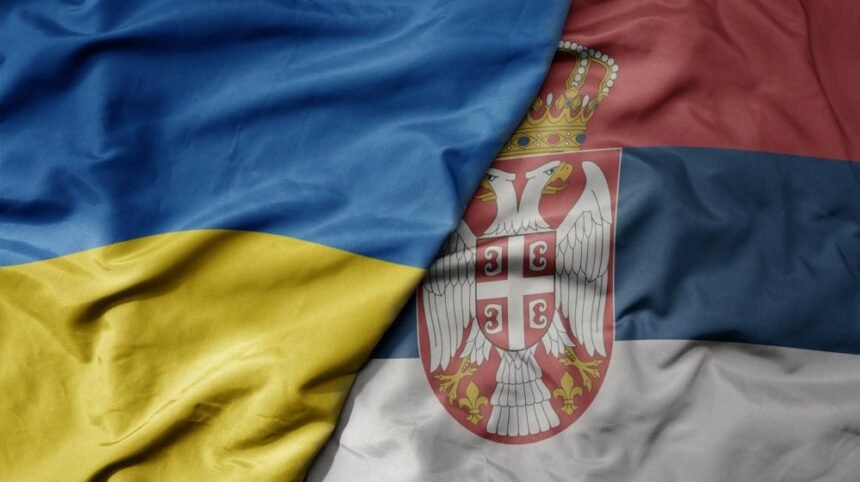
The Ukrainian Embassy in Serbia has expressed hope that Belgrade will assist in securing the return of forcibly deported Ukrainian children from Russia, stating that Serbia’s decision not to participate in the latest UN General Assembly vote on the issue was the result of Russian pressure linked to energy supplies.
In comments to Radio Free Europe (RFE/RL), the embassy said that Serbia’s absence during the vote condemning the forced deportation of Ukrainian children to Russia was explained by the Serbian government as a matter of protecting its “national interests.”
“We are aware of the complexity of the current moment – the Kremlin has openly begun to blackmail Serbia by delaying the resolution of energy supply issues,” the Ukrainian Embassy in Belgrade stated.
The embassy added that, as an EU candidate country, Serbia should support international efforts to achieve peace, which explicitly includes the return of abducted Ukrainian children.
“We expect that an EU candidate state will align with the common European policy toward the aggressor state, Russia, and will help us bring our children back to Ukraine,” the embassy said.
UN Vote and Regional Context
The UN General Assembly resolution demanded the “urgent, safe and unconditional return of all Ukrainian children forcibly transferred or deported to Russia.”
A total of 91 of 193 UN member states voted in favor, 11 countries voted against, and 57 abstained.
The U.S. and EU member states supported the resolution, while Russia, Belarus, and North Korea were among those who opposed it.
Serbia did not participate in the vote, becoming—alongside Turkey—the only EU candidate country that did not support the resolution. All other Western Balkan countries — Bosnia and Herzegovina, North Macedonia, Montenegro, and Albania — voted in favor.
Background on Deportations and ICC Warrant
Ukraine accuses Russia of abducting tens of thousands of Ukrainian children since the start of the full-scale invasion in 2022 and relocating them to Russia or Russian-occupied territories without parental consent. Moscow claims it is “protecting vulnerable children from war zones.”
In March 2023, the International Criminal Court issued an arrest warrant for Russian President Vladimir Putin, accusing him of the war crime of illegal deportation of children. Russia dismissed the warrant as “shameful and unacceptable.”
Serbia’s Position Toward Ukraine Since 2022
Since Russia’s invasion in February 2022, Serbia has supported several UN resolutions affirming Ukraine’s sovereignty and territorial integrity.
- In April 2022, Serbia voted to suspend Russia from the UN Human Rights Council.
- In October 2022, it backed a resolution condemning Russia’s annexation of four Ukrainian regions.
- In November 2022, Serbia abstained from a resolution calling for Russian accountability and reparations to Kyiv.
On the third anniversary of the invasion (February 24, 2025), Serbia voted in favor of a UN resolution reaffirming support for Ukraine — but President Aleksandar Vučić later claimed Serbia had voted “by mistake” and should have abstained.