Ukraine’s latest peace proposal includes an unexpected incentive aimed directly at U.S. President Donald Trump: the creation of a demilitarized “free economic zone” in the Donbas where American businesses would be encouraged to invest.
The measure — part of a revised 20-point peace plan — reflects Kyiv’s growing urgency to secure Washington’s engagement as negotiations to end Russia’s war intensify across Europe.
A Plan Designed to Appeal to the White House
Trump, who publicly expressed skepticism about the likelihood of a near-term breakthrough, has been briefed on the new proposal, according to his spokesperson Karoline Leavitt.
Ukrainian President Volodymyr Zelenskyy confirmed on Thursday that the plan envisions a demilitarized buffer zone in eastern Ukraine, with neither Russian nor Ukrainian troops allowed to operate there.
He described the idea as a “compromise”, noting that the original U.S.-drafted 28-point proposal — designed with Russian input — would have granted Russian forces primary control of the region.
But Zelenskyy emphasized that Ukraine would only withdraw its forces after receiving robust security guarantees from allied nations to prevent future Russian aggression.
Doubts About Moscow’s Willingness to Cooperate
Two individuals familiar with the negotiations, speaking on condition of anonymity, said they expect Russia to reject the revised plan.
According to them, Trump’s team continues to see Ukraine as the weaker party — a perception reinforced by the recent anti-corruption scandal that forced Zelenskyy’s powerful chief of staff Andriy Yermak to resign.
One source said the White House is leveraging the scandal to pressure Kyiv, further complicating European diplomatic efforts.
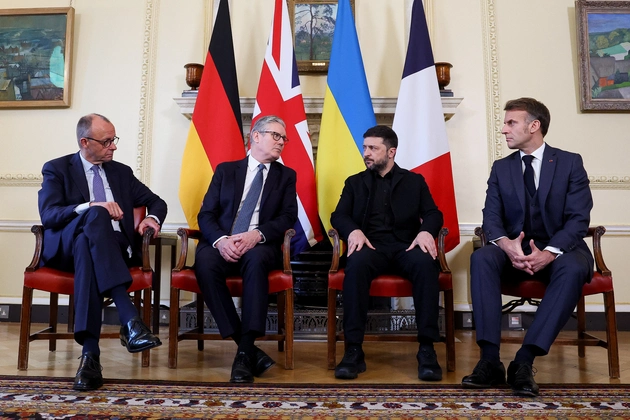
European leaders have urged Trump to travel to Berlin next week for continued talks. But according to these sources, Trump is unlikely to go unless Ukraine and its partners offer substantial modifications to the proposal.
Leavitt would not clarify Trump’s position, stating only that the administration will send a representative to upcoming talks “if we feel like those meetings are worthy of someone on the United States’ time.”
U.S. and European Roles Still Being Negotiated
Trump’s special envoy Steve Witkoff is expected to participate in discussions with national security officials in the coming days.
Meanwhile, Trump continues to insist that Europe — not the U.S. — must bear most of the responsibility for the security guarantees Ukraine is seeking.
Zelenskyy said he had a “constructive and in-depth conversation” with U.S. Secretary of State Marco Rubio, Defense Secretary Pete Hegseth, Witkoff, Jared Kushner, senior Pentagon representatives, and NATO Secretary-General Mark Rutte.
Europe Prepares Its Own Security Commitments
A senior European defense official said allies in Europe are already planning to deploy troops and surveillance assets to Ukraine to monitor any eventual peace agreement.
These coalition troops would conduct drone reconnaissance inside Ukraine and maintain a presence on the ground — though not on the front line.
European frustration with Washington is growing, the official noted, due to their limited involvement in shaping earlier U.S.–Ukraine discussions.
U.K. Defence Secretary John Healey said the “Coalition of the Willing” — more than 30 nations — is prepared to “do the heavy lifting in Europe” to secure peace and support long-term security guarantees.
NATO Accession Still a Major Point of Contention
Trump has repeatedly stated that Ukraine will not join NATO, contradicting long-held U.S. and European policy.
The revised peace plan reportedly removes language that would permanently bar Ukraine from joining the alliance — a shift that may please Kyiv but is unlikely to satisfy Moscow.
Trump and Russian President Vladimir Putin have both pushed for Ukrainian elections once a peace agreement is reached. The new plan aligns with that demand, calling for elections shortly after the cessation of hostilities.
But Russia continues to insist on two non-negotiable points:
- Full control of the Donbas region, and
- A permanent veto on Ukrainian NATO membership.
With those demands still unresolved, and with skepticism rising in both Washington and Moscow, the prospects for rapid progress remain uncertain — despite Europe’s increasingly urgent diplomatic push.