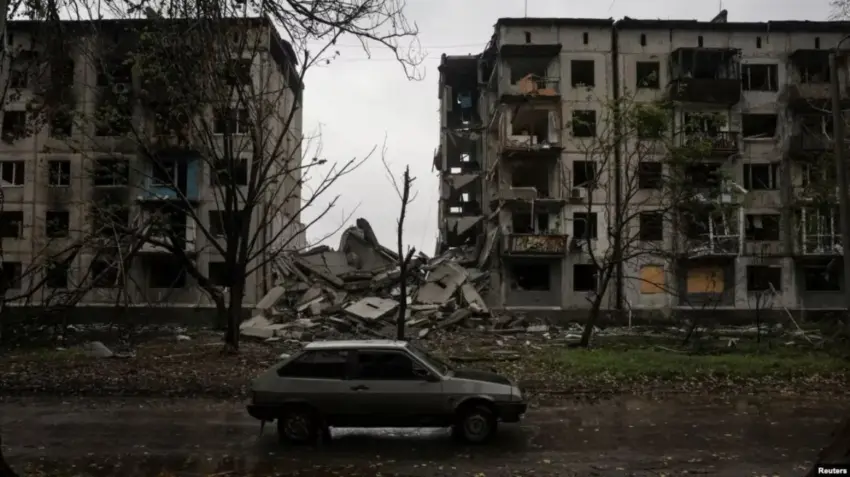
A Ukrainian security expert has warned that Serbia’s actions in Kosovo closely resemble the hybrid tactics used by Russia in Ukraine, particularly through provocation, denial, and pressure on political and security structures.
Speaking to TV1, Vadym Chernysh, Chairman of the Supervisory Board at the Ukrainian Center for Security and Cooperation Studies, said that Serbia appears to be applying methods similar to those used by Moscow since the start of the war in Ukraine.
Testing Political and Military Responses
Chernysh pointed to Russia’s repeated airspace provocations against NATO member states, including incidents involving Russian drones over Poland and other European countries, as part of a broader hybrid warfare strategy.
According to him, Serbia’s attempted annexation of northern Kosovo, highlighted by the September 24, 2024 attack in Banjska, Zveçan, follows a comparable pattern.
“Constant testing, all the time,” Chernysh said. “Russia tests political leadership to see whether it is ready to make quick and decisive decisions, and it also tests military structures to assess whether defense systems are effective.”
He explained that such actions are a key component of hybrid warfare, combining military and non-military tools while simultaneously applying pressure on governments and civilian populations.
Plausible Deniability and State-Supported Actions
Chernysh emphasized that the Banjska attack was a state-supported operation, but one carried out under the principle of plausible deniability, a tactic Russia used for years prior to its full-scale invasion of Ukraine.
“This is exactly how Russia operated for many years before invading Ukraine,” he said, referring to Serbia’s official denial of direct responsibility despite strong evidence of state involvement.
Europe Seen as a Single Theater
According to the Ukrainian expert, Russia views Europe as a single geopolitical theater, rather than a collection of separate crises in places such as Kosovo, Ukraine, or Western Europe.
“Europe is seen by Russia as one unified theater,” Chernysh said. “Some European governments still see these events as separate or unrelated stories. That is simply not true.”
War in Ukraine Far From Over
Meanwhile, Yevhen Mahda, Director of the Institute for World Policy in Ukraine, said the war in Ukraine is unlikely to end in the near future.
Mahda stressed that the conflict has already lasted more than 45 months and criticized early Western predictions of a swift Ukrainian victory as unrealistic.
“Our war continues, and I believe people in Kosovo can understand this reality,” Mahda said.
NATO Warns of Broader Russian Threat
Concerns over Russia potentially expanding the war into Europe have also been echoed by NATO Secretary General Mark Rutte. Speaking at a meeting of foreign ministers in Brussels, Rutte warned that after Ukraine, NATO itself could become Russia’s next target in an effort to ignite a new conflict.