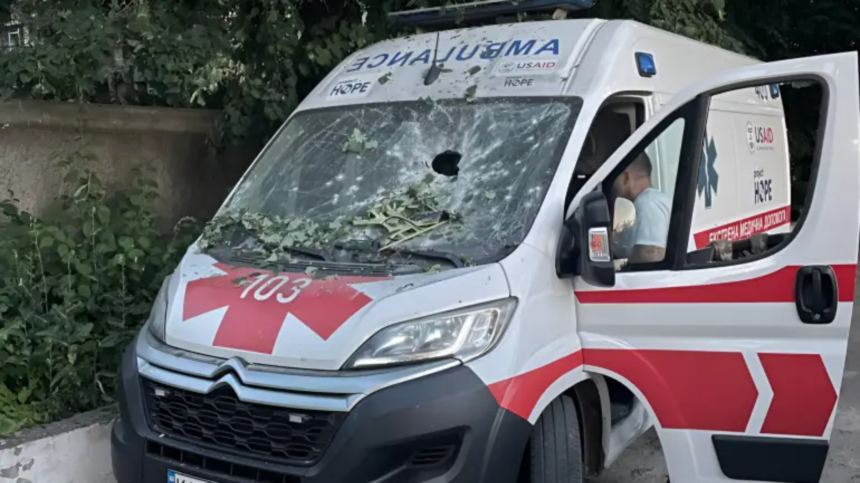
Ukrainian medics continue to face growing threats from advanced Russian drones on the front lines. Vladyslav Dolynniy and his team were inside a medical center in Bilenke, a village along the Dnipro River in Zaporizhzhia, when an explosion alerted them to danger. Outside, a nearby ambulance had been struck by a drone, breaking its rear window and causing damage, though thankfully no one was injured.
This marked the first time an FPV-type drone targeted an ambulance in the Zaporizhzhia region, highlighting a disturbing trend seen across Ukraine. Since the full-scale invasion began on 24 February 2022, medical personnel and vehicles have repeatedly been struck in frontline areas from Sumy in the northeast to Kherson in the south.
As Russia deploys increasingly advanced drones that are harder to detect, frontline medical teams are at greater risk. Ambulances and emergency responders—normally protected under international law—are now being deliberately targeted. Dolynniy explained that even vehicles equipped with jamming devices and drone signal detectors are no longer safe, as fiber-optic drones operate without detectable radio frequencies.
Analyst Serhiy Hrabskiy noted that longer-range drones, capable of striking up to 50 kilometers, are forcing medics to evacuate the wounded further from the front lines, increasing exposure to danger. Rapid drone development also poses challenges for detection systems, which must be continuously recalibrated to track new frequencies.
The World Health Organization confirmed 1,940 attacks on healthcare facilities, vehicles, and personnel in Ukraine as of August 2024—the highest number documented in any humanitarian crisis. Ukraine’s Ministry of Health reports at least 443 emergency vehicles destroyed or damaged and 815 healthcare facilities damaged or destroyed nationwide.
Oleksiy, a medic in the 154th Motorized Brigade, stated: “Medical transport has become a primary target for Russian attack drones. In previous wars, no one touched the Red Cross. Today, ambulances and medics are being attacked, showing the inhuman nature of this conflict.”
Under the Geneva Conventions, mobile medical units and patient transports must never be attacked and must always be protected. Yet regions including Donetsk, Kharkiv, Kherson, Zaporizhzhia, and Luhansk—along the front line—continue to experience repeated strikes. In Herson alone, recent drone attacks injured both a 64-year-old ambulance driver and a 32-year-old medic.
Documentation of attacks is vital for future accountability. Ukrainian lawyer Dmytro Hladkiy emphasizes: “These incidents must be recorded so that in the future no one can claim there was ‘no evidence.’” To date, over 150,000 cases of alleged Russian war crimes and atrocities have been opened, and the number continues to rise with each new attack.