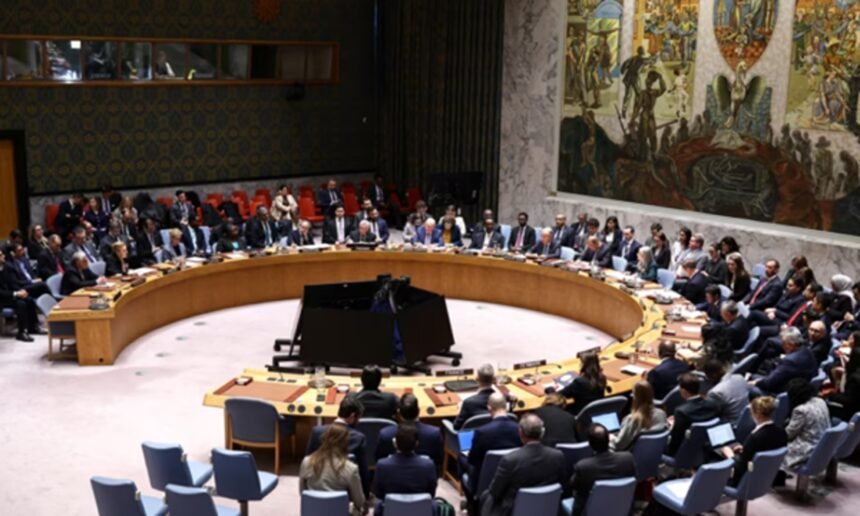
The United Nations Security Council is set to vote on April 4 on a revised resolution aimed at restoring commercial shipping through the Strait of Hormuz, amid divisions among world powers over how far to go in responding to Iran’s blockade of this vital waterway.
The latest draft, submitted by Bahrain, was reportedly softened following objections from veto-wielding members – China, Russia, and France – who opposed the original language allowing states to use “all necessary measures” to secure the strait. This had delayed the vote originally scheduled for April 3.
The revised text permits only “protective measures” to ensure safe passage through the strait and surrounding waters, reflecting a compromise to avoid a veto while still enabling some form of coordinated response.
The vote comes at a critical moment in the war that began with joint U.S.-Israeli strikes against Iran in late February, as Iran’s effective closure of the strait has shaken global energy markets and sparked fears over supply disruptions.
China has publicly opposed any resolution that could legitimize the use of force. Fu Cong, China’s UN ambassador, warned that such authorization would inevitably escalate the conflict and urged a political solution. Jonathan Fulton, a China-Middle East expert at Zayed University in Abu Dhabi, noted that while China lacks strong power to prevent escalation, its veto rights give it significant influence.
Russia has taken a similar stance, emphasizing that the focus should be on ending hostilities rather than expanding maritime security mandates. France, however, signaled possible openness to the revised language, emphasizing the need for protective measures.
The outcome of the April 4 vote remains uncertain, as diplomats closely monitor whether the changes are enough to secure support—or at least abstention—from the Security Council’s most powerful members: the UK, China, France, Russia, and the U.S.
Iran has heavily restricted traffic through the Strait of Hormuz, targeting vessels and tightening control over one of the world’s most critical energy chokepoints, through which about one-fifth of global oil and gas flows. Tehran has also proposed its own management system with Oman, requiring ships to obtain special licenses to pass.
EU foreign policy chief Kaja Kallas criticized this “pay-to-pass” concept, stating that international law does not recognize such schemes. She also spoke on April 2 with Chinese Foreign Minister Wang Yi about the Iran conflict and its global economic impact.
Since the war began, only a limited number of ships, mostly from countries Iran considers friendly, have passed through the strait under Tehran’s prior approval. On April 3, a French-flagged container ship reportedly passed through, likely the first Western European-linked vessel to do so since the conflict began.
U.S. President Donald Trump has indicated that Washington will not take the lead in reopening the waterway, urging Gulf nations that rely on energy supplies to act independently. Gulf states hosting U.S. forces and targeted by Iranian attacks have so far avoided direct retaliation, wary of escalating the conflict into a wider regional war.