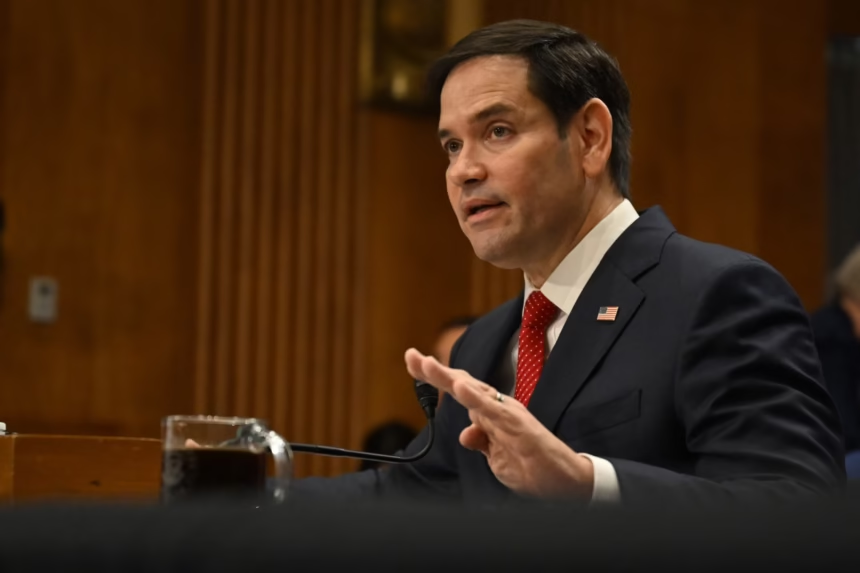
US Secretary of State Marco Rubio will travel this week to Germany to lead a high-level delegation at the annual Munich Security Conference, before continuing to Bratislava and Budapest, the State Department announced.
The trip comes at a critical moment, as Washington and its European allies face heightened tensions over security, trade, and the future of the transatlantic alliance. The ongoing Russia-Ukraine war, now approaching its fifth year since Russia’s 2022 invasion, is expected to dominate discussions, alongside growing concerns related to Iran.
Rubio’s visit highlights the US focus on Central Europe amid strategic uncertainty. In Slovakia, he is scheduled to meet senior officials to advance regional security cooperation and nuclear energy projects, while in Hungary the emphasis will be on bilateral relations and peacebuilding efforts aimed at resolving global conflicts.
A central event of the trip will be Rubio’s address at the Munich Security Conference on February 14, which is expected to receive close scrutiny, especially following last year’s high-profile speech by US Vice President JD Vance, which criticized European leaders for restricting free speech and mishandling migration, leaving lingering unease in Brussels.
The Munich Security Conference annual report underscores the backdrop of these discussions, warning that Europe faces a “prolonged era of confrontation” driven by Russian aggression. It also notes a shift in US thinking on alliances, citing former President Donald Trump as a key figure favoring transactional agreements over principle-based cooperation, with regional influence increasingly dominated by major powers rather than international rules.
US Ambassador to NATO Matthew Whitaker rejected claims of an “internal threat,” emphasizing that Washington aims to strengthen, not dismantle, the postwar order. Whitaker stressed that pressure on European allies to increase defense spending is based on capabilities, not withdrawal, and clarified US positions on trade and strategic interests, including Greenland, framing them in security terms rather than inflammatory rhetoric.
Former US Assistant Secretary for Europe and Eurasia Daniel Fried highlighted the delicate balance facing Rubio, noting that while European allies may perceive a US pullback, the distinction between “rebalancing” and “abandonment” remains crucial. Fried emphasized that historically, US presidents have pushed Europe to assume greater responsibility for its own defense, a strategy intended to strengthen the transatlantic relationship and European influence.