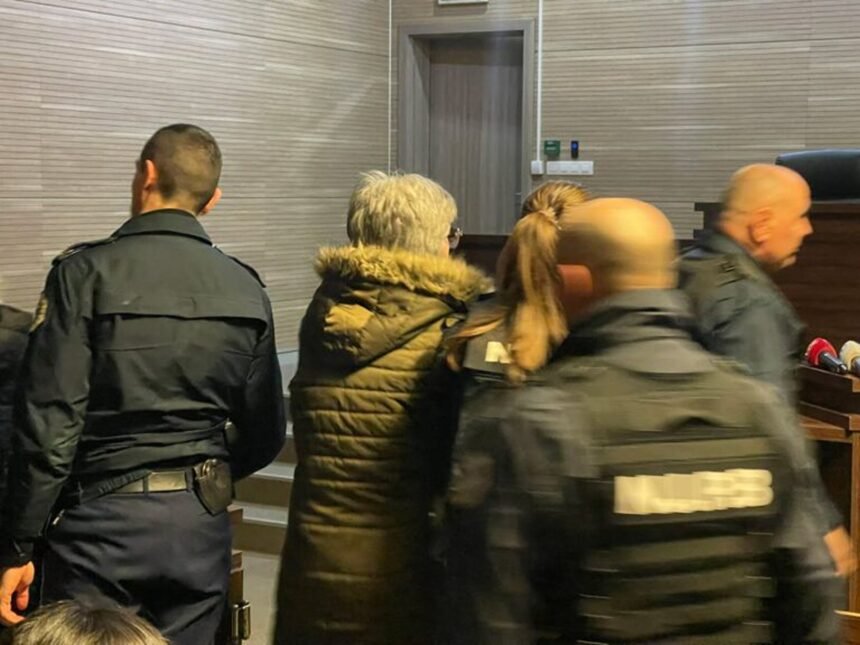
At the Basic Court in Prishtina, victims of the accused Nadica Cepkenović spoke to the media after the first trial hearing, describing systematic physical and psychological abuse and inhumane conditions while imprisoned in the women’s section of Lipjan Prison during the war years.
The testimonies came after Cepkenović, who is charged with war crimes against the civilian population, pleaded not guilty at the initial hearing. The victims said the confrontation after more than two decades brought back heavy and traumatic memories.
Jehona Krasniqi-Morina described the court appearance as emotionally difficult:
“Being in the courtroom always reminded me of the bad, bitter events, the continuous systematic violence—from the moment of arrest until our release. Facing her after nearly three decades was not pleasant at all. It was violent, very violent. There was enormous psychological pressure, continuous for all prisoners. She was not the only one; there were others mentioned in the indictment.”
She added that responsibility should extend to all those involved:
“To achieve justice, all those involved must be held accountable because they were accomplices in the systematic violence, extreme psychological and physical pressure, up to fainting, as the prosecutor mentioned. This is a turning point for us because after twenty years, it is a positive sign that justice is aiming to highlight the violence of someone who truly exerted extraordinary pressure. It was called a prison, but it can be compared to Nazi camps in terms of what was done to Albanian prisoners, regardless of gender, both women and men. Today, we are speaking as female victims in Lipjan Prison. The violence was extraordinary, perhaps impossible to fully describe.”
Another survivor, Mevlyde Saraqi, said she was arrested in July 1998 and the torture was continuous:
“All of us here are victims of that time. I was imprisoned on July 27, 1998, and precisely by her and her colleagues we were tortured 24/7. The tortures varied. We were prohibited from speaking our native language. We could only breathe in a 6-square-meter room. Visits were forbidden, food was denied, communication with each other was blocked, and access to toilets was restricted for 16 hours a day. The conditions were medieval; it was a physical prison in Kosovo, a heavy investigative prison, with criminals like her.”
Saraqi described Cepkenović’s presence in court as the same as in prison:
“Her look today, entering the courtroom, with her ignorance and criminal face, reminded us of everything. For me, today is a day of victory because she is now in the position we once were. But I regret that we taxpayers and journalists fund her upkeep. A criminal like her should be punished, along with others who participated, for the harm caused to us women imprisoned under extraordinary circumstances while working for Kosovo’s freedom and independence.”
She added that prisoners lived in constant fear for their lives:
“We never knew when the door would open and who would be killed. We couldn’t have peace of mind, couldn’t speak Albanian freely. They forced us to speak their language. During walks, we were monitored, hands tied, provoked constantly, beaten, and hearing others’ screams created terror that never let us rest.”
Another victim, Zahrije Podrimçaku Subashi, testified to extreme torture and pressure, including being threatened in a basement. She also said she was forced to step on a photo of Hashim Thaçi but refused despite threats:
“She tried to make me step on Hashim Thaçi’s photo, but I didn’t. They tried everything to break me. I was one of the most tortured women in Serbian prisons—physically and psychologically.”
The first hearing against Nadica Cepkenović was held on Monday at the Basic Court in Prishtina. Cepkenović, born January 8, 1963, in Skopje and residing in Požarevac, is accused of war crimes committed during 1998–1999 in the women’s section of Lipjan Prison, in coordination with Ljiljana Selić, Danica Lukić, Sladjana Arsić, and Biljana Stolić, for systematically mistreating Albanian female prisoners.
The indictment states that the accused allegedly tortured the victims inhumanely with various instruments, including batons, kicks, and punches, causing bodily injuries. They also reportedly inflicted psychological abuse, seriously threatened lives, and as a result of continuous beatings, victims suffered anxiety and fear, with their human dignity severely violated—a trauma they continue to endure today.