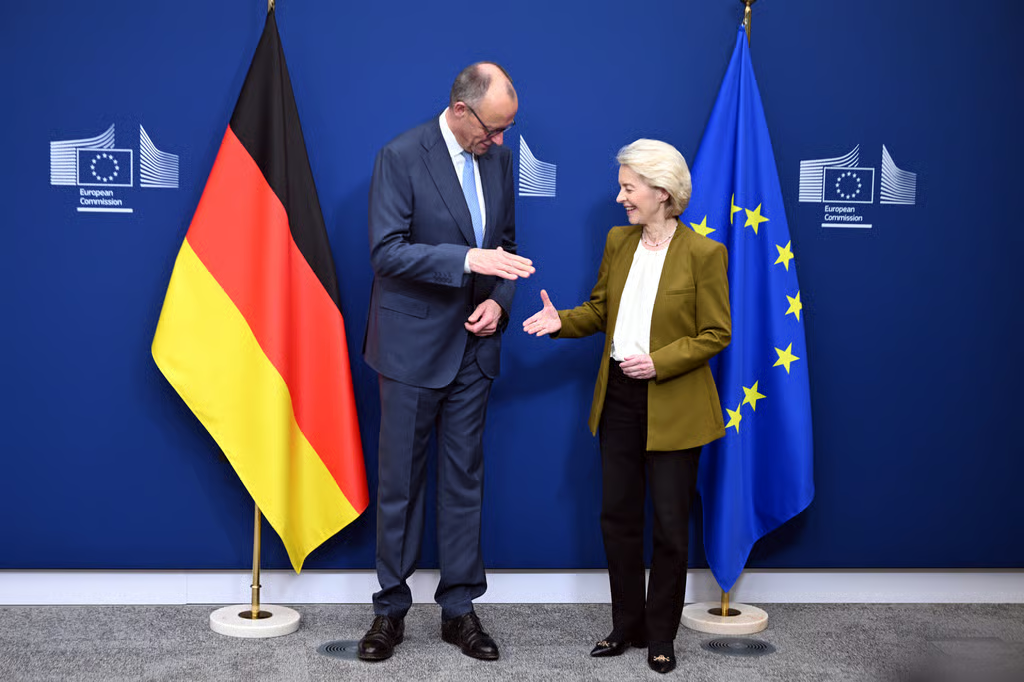
European Commission President Ursula von der Leyen and German Chancellor Friedrich Merz openly clashed over the future of the European Union’s Emissions Trading System (ETS), as political leaders and industry representatives debate the balance between climate action and industrial competitiveness.
EU Carbon Market Sparks Political and Industry Tensions
During a high-level gathering in Antwerp, von der Leyen strongly defended the EU’s flagship climate policy, emphasizing that the ETS has successfully reduced emissions while supporting economic growth.
“The Emissions Trading System brings clear benefits,” von der Leyen said, highlighting that emissions in sectors covered by the ETS have dropped by 39 percent since 2005, while economic output in those sectors has grown by 71 percent. She argued that decarbonization and competitiveness can coexist, rejecting claims that climate policies threaten European industries.
The ETS requires heavy industries, power plants, aviation, and shipping companies to pay approximately €80 per ton of CO₂ emissions, encouraging investments in cleaner technologies. The system currently regulates around half of the EU’s greenhouse gas emissions.
Merz Calls for Possible Revision or Delay
However, German Chancellor Friedrich Merz questioned the effectiveness of the ETS, suggesting it could be revised or postponed if it fails to support industry transition to carbon-neutral production.
“If this is not the right instrument, we should be very open to revising it, or at least postponing it,” Merz said, receiving strong support from industry representatives. He stressed that climate policies must not jeopardize industrial jobs or economic stability, warning that such outcomes would be “unacceptable.”
France Warns Against Industrial Decline
French President Emmanuel Macron also voiced concerns, cautioning against undermining European industry while pursuing ambitious climate targets. He warned that high energy and carbon costs risk accelerating deindustrialization rather than supporting decarbonization, although he urged policymakers not to abandon the ETS entirely.
Commission Pushes for Renewable Investment
Von der Leyen argued that reducing dependence on fossil fuels remains the key to lowering energy costs, stating that renewable and nuclear energy can stabilize prices, while gas markets remain unpredictable. She urged EU leaders to use the current period of lower gas prices to accelerate investments in low-carbon energy infrastructure.
Planned Reforms and Revenue Disputes
The European Commission confirmed that the ETS legislation will undergo review before July 2026, with discussions likely to focus on improving efficiency rather than dismantling the system. Climate Commissioner Wopke Hoekstra reaffirmed the Commission’s commitment to maintaining the ETS, while acknowledging room for reforms.
Von der Leyen also criticized EU member states for failing to reinvest carbon market revenues into industrial decarbonization, noting that less than 5 percent of national ETS revenues currently support green industry transformation.
Growing Debate Over Europe’s Climate and Economic Future
The dispute highlights widening divisions within the EU over how to balance climate ambitions with industrial competitiveness, as businesses warn about rising operational costs while environmental groups caution against weakening climate policies.
The debate is expected to intensify during upcoming EU leadership meetings focused on strengthening Europe’s economic competitiveness and energy security.