European Commission President Ursula von der Leyen has reaffirmed that Ukraine’s accession to the European Union is a central pillar of the country’s future security guarantees, as diplomatic efforts intensify amid renewed tensions with Russia.
Speaking after consultations with European leaders under the Berlin Format — which includes Germany, France and Poland — von der Leyen stressed that EU membership represents a security guarantee in itself for Ukraine.
“Ultimately, the prosperity of a free Ukrainian state lies in accession to the EU,” von der Leyen said, adding that enlargement benefits not only candidate countries but strengthens Europe as a whole.
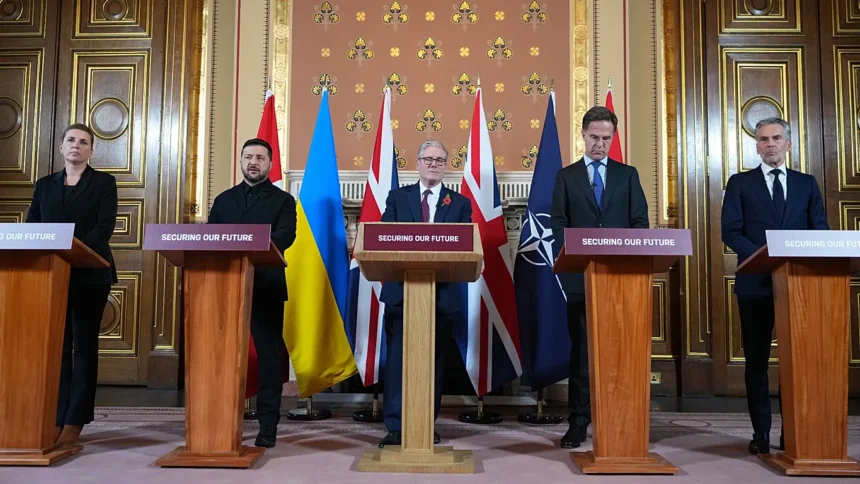
Her remarks come as high-stakes diplomacy continues, with the “Coalition of the Willing” — a group of Ukraine-supporting countries led by France and the United Kingdom — set to convene next week in an effort to consolidate European backing for Kyiv.
EU Accession: Strategic but Challenging
Ukraine’s path toward EU membership remains strategically significant but politically complex. Accession requires far-reaching reforms and unanimous approval from all 27 EU member states.
The European Commission maintains that Ukraine is technically ready to advance in the accession process. However, Hungarian Prime Minister Viktor Orbán has continued to block progress, arguing that Ukraine does not meet the necessary criteria and advocating instead for a looser partnership.
This stalemate has reignited debate over unanimity rules in EU enlargement, though no legal changes have yet materialized.
Peace Talks Strained by Russian Allegations
Momentum toward a US-led peace initiative suffered a setback after Russia claimed that Ukraine attacked a private residence belonging to President Vladimir Putin — an allegation Kyiv has firmly denied, calling it “a total fabrication” aimed at derailing negotiations.
US President Donald Trump, who met Ukrainian President Volodymyr Zelenskyy at his Mar-a-Lago residence, acknowledged being briefed by Putin on the alleged incident but offered no independent confirmation.
“This is not the right time for that,” Trump said, referring to the alleged attack, while emphasizing the need to avoid escalation.
Russian Foreign Minister Sergei Lavrov warned of retaliation, as Russia launched another wave of drone and missile strikes over the weekend, primarily targeting Kyiv.
European leaders reacted cautiously to Moscow’s claims. German Chancellor Friedrich Merz called for “honesty and transparency from everyone — including Russia”, stating that progress toward peace remains possible but fragile.
Security Guarantees and Long-Term Commitments
President Zelenskyy has stated that security guarantees involving the US, Ukraine, and European partners are close to being finalized, though critical issues remain unresolved — particularly territorial concessions, including Russia’s demands over the Donbas region.
Trump acknowledged that Europe would bear primary responsibility for long-term security guarantees, with the US offering support. Zelenskyy, meanwhile, has proposed extending security guarantees from 15 years to as long as 30–50 years, calling such a commitment “historic” given Russia’s decade-long aggression.