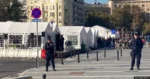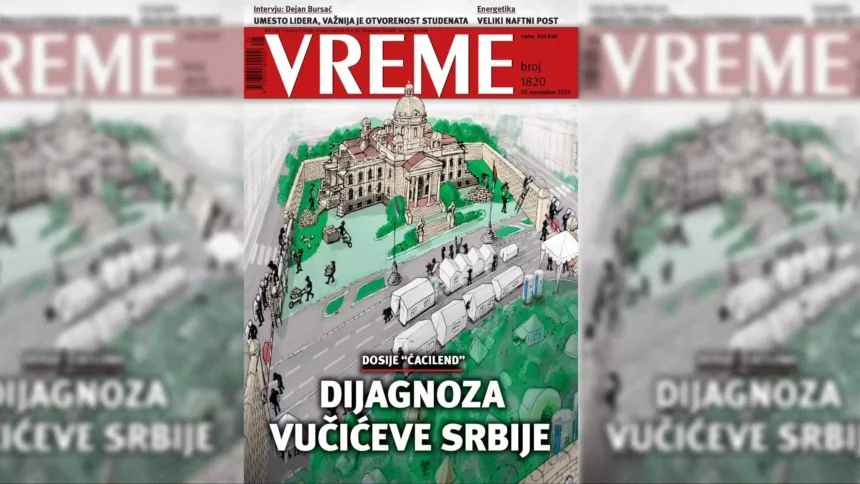
“Ćacilend” is not just a bizarre spectacle, according to sources for Vreme, but serves multiple functions. Keeping this eyesore in the city center costs the authorities, yet removing it now and acknowledging a kind of defeat would be even more costly.
For eight months—without a single pause—blockaders have occupied Pionirski Park and the area in front of the National Assembly.
While epic protests against the government flare up and fade, street clashes erupt in waves, and hunger strikes come and go, the tent camp in central Belgrade remains.
The horror and purpose of Ćacilend are explored in the cover story of the new issue of Vreme, hitting kiosks Thursday, 20 November. Interviewees present various theories about its meaning, from symbolic or strategic territorial occupation to a paramilitary function.
A Strategic “Black Box”
Political analyst Milorad Đurić says many have mistakenly dismissed the camp as merely bizarre. It functions as a means of occupying space and sending the message that the regime will prevent another “Fifth October” scenario.
“It is also about introducing a permanent ‘state of emergency,’” Đurić explains. “Assuming sovereignty lies with the authority deciding on emergencies, the regime has consciously suspended the legal system in part of the capital, creating a ‘black box’—a space with unknown internal structures and an unexplainable mechanism of operation where legal norms clearly do not apply.”
He adds that Ćacilend is a constant irritation and provocation to citizens, a hook designed to lure people into encounters with police brutality.
A High Cost for the Authorities
Dragan Popadić, psychology professor at the University of Belgrade, says the tent camp also serves as a protective ring around the Presidency and National Assembly, populated mainly by people with criminal records whom Vučić currently trusts most. The police are there to protect and serve this group.
“The cost for the authorities is high, not only financially—these are, after all, public funds—but also propagandistically,” Popadić says. “The camp is an obvious eyesore: tents and toilets in the city center, passed daily by thousands of Belgraders, and increasingly broadcast worldwide as the image of the Serbian regime. Its sinister purpose is becoming clearer every day.”
Removing It Could Signal Defeat
Political analyst Viktor Stamenković believes that removing the camp now would be even more costly for the regime.
“Ćacilend represents a fortress of power that the authorities themselves have elevated to such a symbolic height that any withdrawal or removal would constitute a defeat. The fate of the regime is perceived as tied to the fate of Ćacilend.”