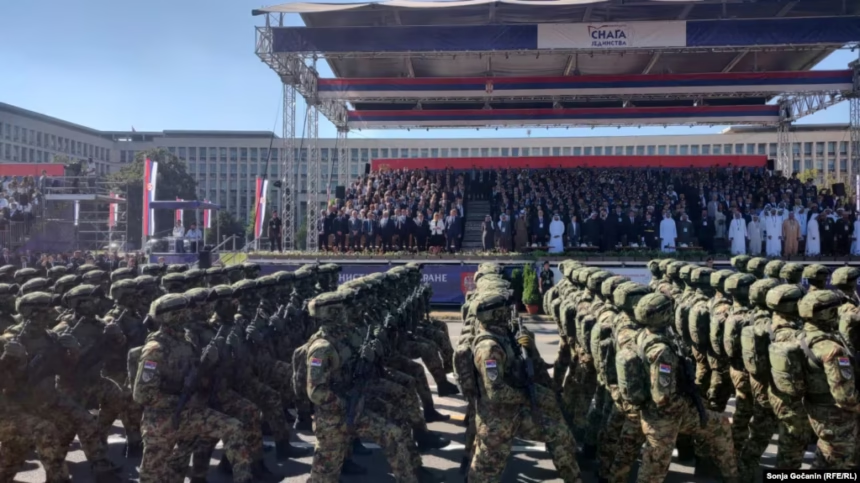
Serbian President Aleksandar Vučić has announced the reintroduction of mandatory military service, stating that conscription could begin as early as December 2026 or March 2027, depending on the readiness of military infrastructure and facilities.
Speaking on 29 January after a meeting with Serbia’s top military leadership on the state and capabilities of the Serbian Armed Forces for 2025, Vučić said that a final decision would be made within the next one to two months, after which the proposal would be sent to parliament and the registration of conscripts would begin.
“We will make that decision soon, in the coming month or two, go before parliament, and start registering military conscripts,” Vučić said.
According to the president, mandatory military service would last 75 days.
Infrastructure Not Ready, Decision Pushed Forward Anyway
Vučić acknowledged that Serbia is not fully prepared to implement conscription immediately, citing shortcomings in infrastructure.
“We have enough rifles and boots, but there are things that are not yet fully ready,” he said, adding that recruitment centers must be renovated, medical facilities upgraded, and logistics improved.
Despite these unresolved issues, Vučić framed the move as a way to instill “discipline, responsibility, and patriotism” in young people — a narrative that critics say increasingly mirrors militarized nationalism rather than genuine defense reform.
Political Context and Critics’ Concerns
The reintroduction of conscription requires parliamentary approval, yet the initiative has been driven top-down, with little public debate on costs, necessity, or regional security implications.
Officials from the ruling establishment have floated the idea for years, but it became concrete in January 2024, when Serbia’s General Staff formally proposed reinstating military service. Vučić approved the initiative in September 2024, reversing Serbia’s 2011 decision to abolish compulsory service and move to a fully professional army.
Analysts and civil society groups have repeatedly warned that the lack of transparent justification, combined with Vučić’s tightening control over institutions, raises concerns that conscription could be used as a political tool — particularly amid rising regional tensions and internal pressures on the regime.
Regional and International Context
Croatia reintroduced mandatory military service in October 2025, while several European countries — including Switzerland, Norway, Finland, Austria, and Greece — never abolished conscription. However, critics note that Serbia’s security environment and governance standards differ significantly, making direct comparisons misleading.