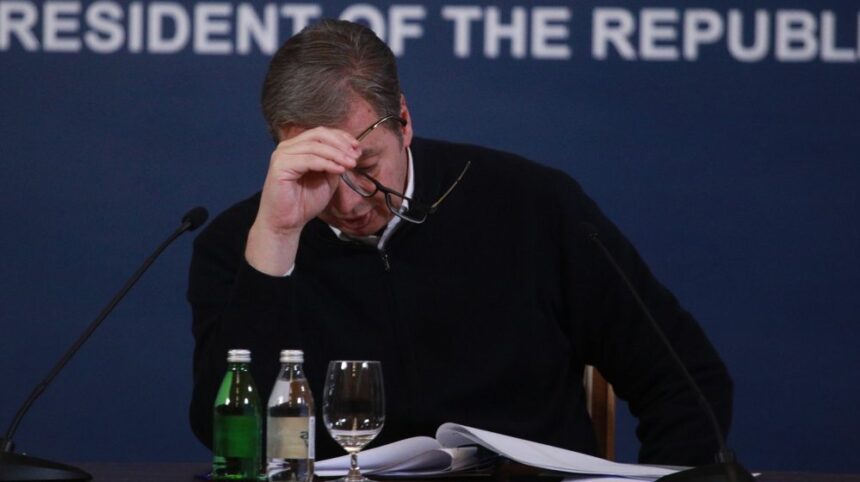
Serbian President Aleksandar Vučić described the upcoming visit of a European Parliament (EP) delegation to Belgrade as a visit by “enemies of Serbia,” drawing criticism from political analysts and raising questions about the potential consequences for the Serbian public.
“They decided themselves to visit Belgrade one day in January. We neither invited nor were informed. You can’t expect me to attend a celebration if I’m not invited first,” Vučić said, responding to opposition and public criticism over his absence during the delegation’s official visit.
The remarks come amid a long-running dispute between Vučić and the EP, especially directed at Tonino Picula, the EP’s special rapporteur for Serbia. Vučić, referencing Picula’s Croatian nationality, framed the visit as a form of historical animosity, linking contemporary criticism to past inter-ethnic tensions.
Analysts warn that such rhetoric, which conflates Serbia’s international reputation with Vučić’s personal standing, harms not only the president but the entire country. Political consultant Dušan Milenković suggested that Vučić likely had pre-scheduled international engagements in Davos and Estonia, and used the EP visit to stage a public narrative portraying himself as defiant and patriotic.
Experts emphasize that the EP delegation also includes members of the European People’s Party (EPP), of which Serbia’s ruling SNS party is an associate member. Vučić’s approach may therefore strain relations with the EPP, reinforcing perceptions that Serbia’s government is not fully committed to European integration.
“There is no positive outcome from this decision except satisfying a small segment of far-right voters. Politically, it risks distancing Serbia from the EU and damaging the country’s long-term interests,” said Goran Miletić, founder of the Balkans Forward Foundation.
Similarly, Đorđe Pavićević, MP and professor at the Faculty of Political Sciences in Belgrade, noted that Serbia has long paid a high price for such confrontational international policies.
“Earlier, costs were offset through resource concessions and corrupt contracts. Today, without strong international support, such tactics risk economic difficulties and international isolation,” Pavićević warned.
Observers agree that Vučić’s rhetoric and resistance to the EP visit may deepen Serbia’s isolation, affect EU relations, and indirectly impact citizens through political, economic, and diplomatic consequences.