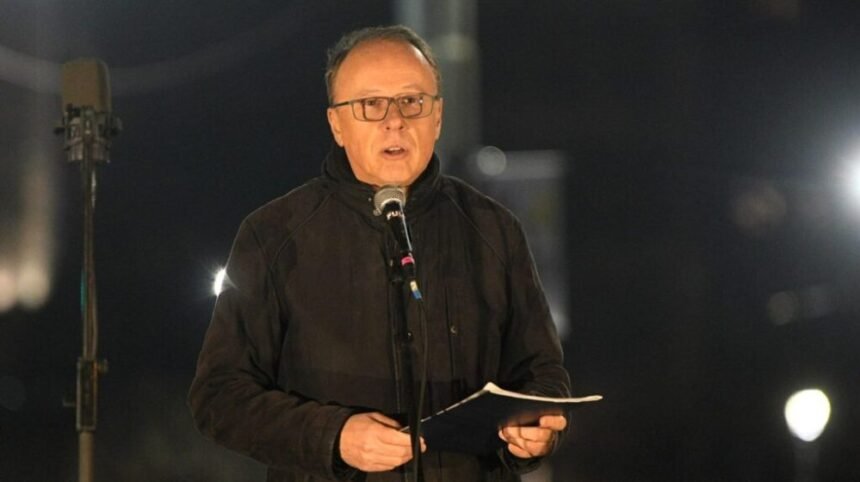
A brief but sharply worded speech by Belgrade University Rector Vladan Đokić at the “Knowledge Is Power” protest on January 27 has triggered a new wave of political and media attacks against him, including calls from senior government officials for his resignation.
Despite lasting only a few minutes, Đokić’s address delivered clear and direct criticism of pressures on the autonomy of universities, resonating strongly with students and the wider public. Shortly after the protest, pro-government tabloids and officials accused him of “abusing the university,” engaging in political activity, and showing sympathy for student blockades.
In the absence of substantive counterarguments, some media outlets focused on a minor verbal slip, when the rector mispronounced a single word. However, academics say this distraction failed to overshadow the core message of his speech—that young, educated citizens are being treated as a problem because they refuse to remain silent and want to build their future in Serbia.
Academics: Attacks Reflect Fear of Organized Resistance
According to Vladimir Mihić, professor at the Faculty of Philosophy in Novi Sad, the attacks on Rector Đokić are part of a broader effort to undermine the academic community, which he describes as the strongest organized resistance to the current government since 2012.
He argues that student-led protests since November 2024 have significantly shaken the ruling structure, forcing authorities to seek a recognizable individual to target.
“When a movement involves hundreds of thousands of people, the regime needs a face to attack. Rector Đokić has become that symbol,” Mihić said.
He added that Đokić represents a vision of Serbia grounded in knowledge, institutional integrity, and future-oriented governance, which he believes deeply unsettles the ruling elite.
Seen as a Potential Political Challenger
Several academics suggest that the intensity of the attacks is linked to fears that Đokić could emerge as a serious political contender, potentially as a future presidential or prime ministerial candidate.
Mihić warned that such a scenario could open the door to investigations into corruption, intimidation, and organized crime, accumulated during more than a decade of rule by the Serbian Progressive Party (SNS).
“Even if they remove him from the equation, thousands of new leaders will emerge. That is what truly frightens the regime,” he said.
Strong Public Support and Growing Pressure on the Government
Maja Kovačević, Dean of the Faculty of Political Sciences in Belgrade, emphasized that Đokić’s speech systematically outlined the pressures facing higher education institutions and noted the large turnout at the protest as evidence of public backing.
“The rector enjoys broad support, and attempts to discredit him ahead of potential elections will fail,” she stated.
Similarly, Branimir Jovančićević, professor at the Faculty of Chemistry, said that Đokić’s leadership during a turbulent period has strengthened confidence within the academic community.
“A rector who is good for the university and society is, by definition, a problem for an autocratic system,” Jovančićević said.
“Vučić Has Many Reasons to Worry”
According to Jovančićević, the scale and coordination of the attacks indicate genuine concern within the ruling circles.
“If there were doubts before, they are gone now. The government is clearly afraid. President Vučić has many reasons to worry,” he concluded, adding that delaying elections may only intensify public resistance rather than suppress it.