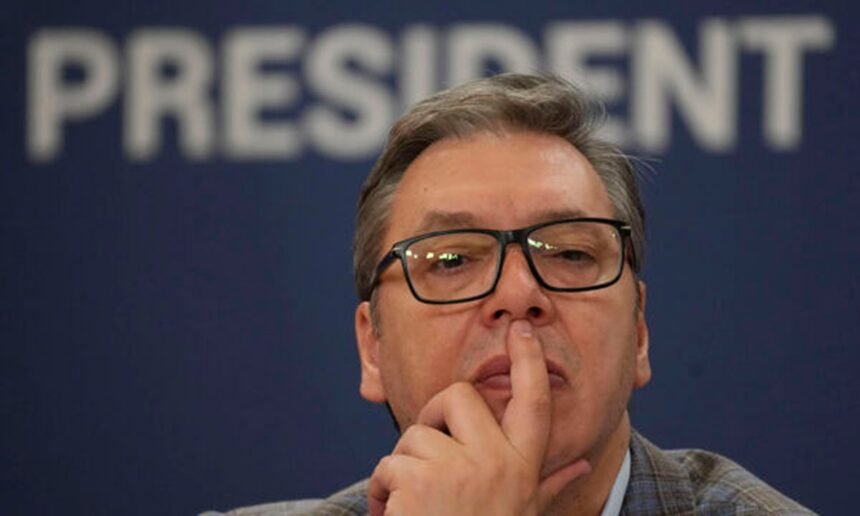
Serbian President Aleksandar Vučić proposed the formation of a dedicated operational team on January 25, aimed at speeding up Serbia’s progress on its European Union accession path, during a thematic session of the Serbian government.
Vučić suggested that the new operational team should consist of eight to ten members, capable of daily coordination through constant communication, in order to intensify reform efforts and improve institutional efficiency. He proposed that the team be headed by Danijel Apostolović, Serbia’s Head of Mission to the EU in Brussels.
According to Vučić, the initiative is necessary because existing coordination mechanisms have proven insufficiently effective, slowing down reform implementation. He reaffirmed that Serbia remains firmly committed to its European course, despite internal and external challenges.
During the same government session, Vučić sharply criticized the performance of several ministers and directors of public enterprises, announcing that personnel changes and dismissals remain a possibility.
Relations With the United States
Although Vučić previously announced from Davos that two formal requests from the United States—which could open the door to a strategic dialogue with Serbia—would be discussed at the session, the topic was ultimately not addressed.
Earlier, Vučić told TV Prva that he was grateful to Washington for several decisions, including:
- The suspension of strategic dialogue with Kosovo
- The extension of an operational license for Serbia’s Oil Industry (NIS), despite U.S. sanctions linked to majority Russian ownership
- Serbia’s exclusion from the U.S. list of countries facing immigration visa suspensions, which he described as an important political signal
The U.S. Office of Foreign Assets Control (OFAC) extended NIS’s operational license until February 20, allowing the company to continue operations despite sanctions.
Criticism of European Parliament Delegation
Vučić also commented on the recent visit of European Parliament members to Belgrade, calling their meeting with Serbia’s opposition “the most ridiculous in the world.”
He criticized what he described as excessive attention given to the delegation, labeling the eurodeputies “completely irrelevant.” Vučić further stated that the opposition’s request for personalized sanctions against members of the ruling Serbian Progressive Party (SNS) was an act of audacity.
The five-member European Parliament delegation, led by Portuguese MEP Marta Temido, visited Serbia from January 22 to 24. Neither Vučić nor Parliament Speaker Ana Brnabić met with the delegation, citing prior commitments abroad—claims later disputed by the European Parliament.
The delegation held meetings with government representatives, parts of the opposition, media, civil society organizations, and academic institutions. Pro-European opposition figures requested that EU Growth Plan funds for the Western Balkans be redirected toward civil society and independent media, along with targeted sanctions against ruling party officials.
Following the visit, the eurodeputies are expected to submit a report to a European Parliament committee, amid broader EU concerns over political polarization and increasing repression in Serbia.