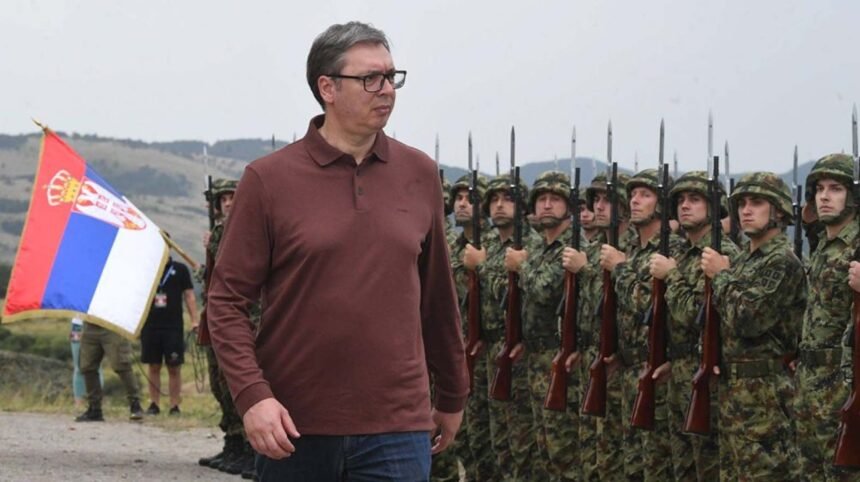
Serbian President Aleksandar Vučić has once again announced the reintroduction of mandatory military service, presenting it as a measure to strengthen Serbia’s defense and “educate” young people. Behind this narrative, however, analysts see a far more troubling motive: the use of militarization as a political instrument to manage internal crisis, social unrest, and declining legitimacy.
Although the return of conscription has been floated for more than a year, Vučić’s sudden urgency raises serious questions about intent. Serbia faces no immediate external military threat, yet the government is accelerating a process that fundamentally reshapes society, youth, and civil-military relations.
Speaking during a visit to a Belgrade barracks, Vučić claimed that mandatory service would enhance Serbia’s “deterrent capabilities” and instill discipline among young people. Critics argue this rhetoric masks a reality in which the army is being politicized and youth are being treated as a controllable resource rather than citizens with rights.
Security and geopolitics consultant Nikola Lunić points out that the proposed 75-day military service is militarily ineffective. Such a short period, he notes, can only produce minimally trained reservists, incapable of operating modern systems such as drones or advanced combat technologies. “Numbers may increase on paper, but real operational capacity will not,” Lunić warns.
More critically, Lunić stresses that Serbia’s armed forces already suffer from deep personnel shortages—both professional and reserve—and that forced conscription does nothing to solve the core problem: lack of motivation, trust, and credibility.
Analysts also reject the government’s claim that global instability necessitates this move. While some European countries have reassessed defense policies following Russia’s invasion of Ukraine, Serbia’s own strategic documents do not identify any immediate security threat. Instead, experts argue that the real pressure is domestic.
According to Lunić, the ruling regime is facing a profound internal political and social crisis, marked by polarization, protests, and eroding public trust. In this context, conscription appears less like a defense reform and more like a populist distraction—an attempt to manufacture patriotism, suppress dissent, and divert attention from unresolved political and economic problems.
Military analyst Aleksandar Radić goes further, warning that the process lacks transparency, legal clarity, and public consensus. Despite the absence of a proper legal framework, budget funds have already been allocated, revealing a top-down push driven by political will rather than democratic debate.
Radić highlights a particularly alarming dimension: timing. With society deeply divided and protests involving large numbers of young people, the first generation of conscripts would likely include those who openly opposed the government.
“Forcing politically critical youth into a system that demands unconditional loyalty and constantly invokes external threats is extremely dangerous,” Radić warns. “It raises serious questions of trust, coercion, and abuse of state power.”
While Radić supports military training in principle, he emphasizes that such a reform must be long-term, consensual, and professional—not a short-term political maneuver. The failure of Serbia’s professional army model, he argues, cannot be fixed through compulsion, but through systemic reform, incentives, and respect for citizens.
Despite this, Vučić continues to reduce the issue to personal declarations, sidelining institutions, experts, and public discussion. The army itself has been reduced to a political backdrop, echoing presidential talking points rather than independently assessing national defense needs.
With plans already embedded in the 2026 budget—nearly €90 million allocated over three years—the government is clearly moving ahead regardless of public concern. Polls cited by officials claiming broad public support have not been accompanied by transparent methodology or open debate.
What Vučić presents as a patriotic necessity increasingly appears as a strategy of control: using uniforms, discipline, and fear to compensate for political fragility. In a society that urgently needs dialogue, trust, and de-escalation, the push for mandatory military service risks deepening divisions and turning the army into yet another instrument of power.