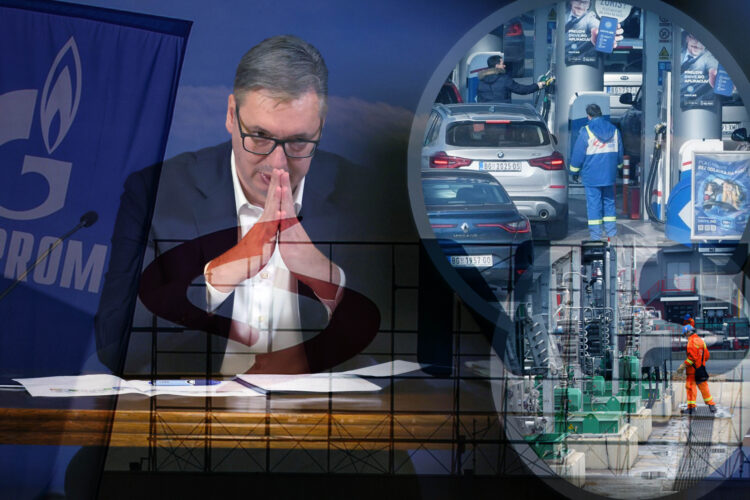
It is now almost certain that the United States will not issue a license to the Petroleum Industry of Serbia (NIS), placing thousands of workers in the company and its subsidiaries at risk of losing their jobs unless the Serbian state urgently takes control.
Despite the severity of the situation—and the predictable rise in fuel prices and broader cost-of-living increases—President Aleksandar Vučić has given Russia an additional 50 days to sell its stake in NIS. Employees are increasingly anxious, even though officials insist a solution will be found.
The estimated price of €1.4 billion to buy out Russia’s stake is only one part of the problem. NIS and its seven subsidiary companies employ over 12,600 people.
Yet, Vučić continues to delay, granting Moscow more time despite knowing that Russia has no intention of selling its controlling share in Serbia’s strategic oil company.
Economist Vladimir Vasić warns that employees will suffer the most if the state does not assume control quickly and restore normal operations.
“In the current situation, NIS could only pay one to three more salaries from ongoing business activities. People are scared, and they need something to live on.”
Widespread Consequences for Serbia, Not Just NIS Workers
Vasić notes that Serbia’s dependence on NIS is profound:
- NIS processes around 30 million barrels of oil annually, earning $5–15 per barrel.
- In the worst-case scenario, this amounts to $150 million in revenue from refining alone.
- The company has historically recorded profits between €200 million and €800 million, with annual revenues reaching €3.5 billion.
- NIS contributes roughly €2 billion to Serbia’s state budget.
This means the entire country—not just NIS employees—is exposed, as Vučić’s refusal to act decisively endangers Serbia’s fiscal stability, energy security, and thousands of supply-chain jobs linked to the sector.
Uncertainty Over Salaries
Milan Ćulibrk, editor of Radar’s economic desk, says NIS may only have enough money for salaries through December and January:
“Workers were promised salaries, but there will be no new income. Why Vučić insists on waiting 50 more days is unclear—this could have been resolved already. By February, something must be done.”
He adds that few are discussing the two million small shareholders who also stand to be affected.
Ćulibrk insists that massive layoffs are unlikely—if the state takes over, it will still need the workforce—but he warns:
“What worries me is what will happen once our government takes control. We all saw what happened to EPS after political appointments filled the company.”
Growing Panic Among Employees
Workers at NIS acknowledge that fear is spreading:
“People are panicking, but still hope the situation will be resolved,” a company insider told Nova.rs.
Although NIS’s website lists over 13,000 employees, official APR data shows 5,161 employed directly by NIS.
However, with its subsidiaries—most notably Petrohemija with 1,224 employees—the true number exposed to risk is far higher.