What began as a local protest in the Botun settlement in Montenegro’s Zeta municipality escalated into a regional political controversy after Serbian President Aleksandar Vučić publicly вмеша himself in the situation, spreading false claims that Montenegrin politician Milan Knežević had been arrested.
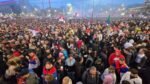
In the early morning hours, hundreds of residents gathered in Botun following reports that police would intervene to secure land designated for the construction of a wastewater treatment plant, a project backed by the Montenegrin government and the city of Podgorica. Protesters had been camping at the site for days, opposing the project over environmental and health concerns.
Police surrounded the area and ordered demonstrators to leave and remove their vehicles. When the crowd refused, officers began pushing protesters back, announcing the use of minimal coercive measures. Some demonstrators sat on the ground singing, while others shouted at police. Approximately 200 police officers, along with medical teams and journalists, were present.
Detentions and Disputed Claims
Around 50 people were detained, including Zeta Municipality President Mihailo Asanović. However, contrary to claims later made by Serbian officials, Milan Knežević, leader of the Democratic People’s Party (DNP), was not arrested.
According to unofficial police sources, Knežević voluntarily entered a police van (“marica”) after a brief argument, at a moment when police operations were already concluding. Authorities stated that he was neither detained nor ordered to enter the vehicle and had even refused police requests to step out, precisely because he had not been arrested.
Vučić’s False Narrative
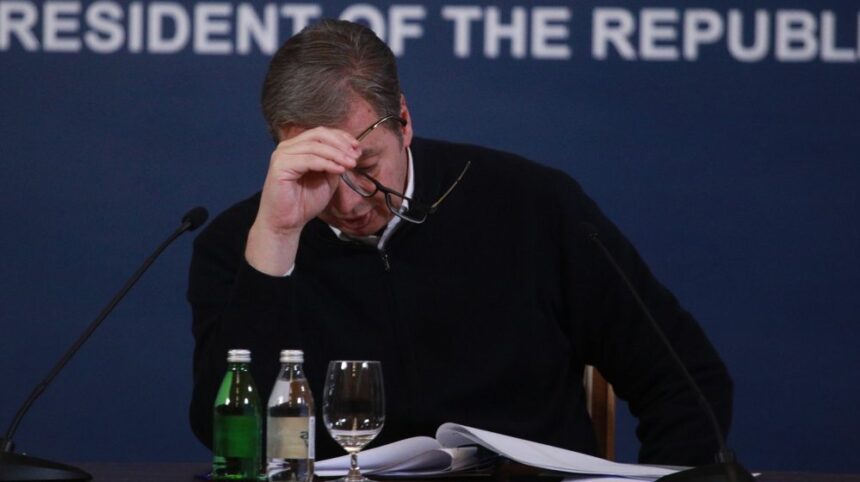
Despite these facts, President Vučić posted a message on Instagram, claiming that Knežević had been “arrested” and portraying him as “the leader of the Serbian people in Montenegro”.
“Today in Montenegro, the leader of the Democratic People’s Party—and more importantly, the leader of the Serbian people, Milan Knežević—was arrested. He defended the will of the people expressed in the referendum,” Vučić wrote.
The statement sparked strong reactions in Podgorica, where officials accused Vučić of spreading disinformation and interfering in Montenegro’s internal political and security affairs.
Serbia’s ruling party leader Miloš Vučević further escalated tensions by accusing Montenegrin police of “violence” and presenting Knežević as a symbol of Serbian resistance, while ignoring the dozens of citizens who were actually detained.
Montenegro Responds: “Solidarity Based on Disinformation”
An official response came from Montenegro’s Deputy Prime Minister and Foreign Minister Filip Ivanović, who said that the expressions of solidarity from Serbia were “based on disinformation.”
“Their ally and friend was not arrested. He voluntarily and unprovoked entered a police van and refused officers’ explicit requests to leave it—precisely because he was not under arrest,” Ivanović stated.
He warned regional politicians that any reaction must be grounded in verified facts, not political constructions.
Personal and Political Ties
The controversy is further fueled by the close political and personal relationship between Vučić and Knežević. Vučić recently publicly thanked Knežević for attending his family celebration of St. Nicholas Day, raising questions about whether the Serbian president’s reaction reflects political protection of an ally rather than principled concern for human rights.
EU Project at the Core of the Dispute
At the heart of the Botun protests lies the construction of a wastewater treatment facility, seen by Montenegrin authorities as essential for environmental protection and compliance with EU standards under Chapter 27 of accession talks.
Podgorica’s existing system is outdated, with most wastewater flowing directly into the Morača River and Lake Skadar, affecting public health and ecosystems. However, residents of Botun and Zeta fear the new plant could pose environmental risks, citing previous unresolved pollution issues, including industrial waste.
The project is directly tied to EU funding, and delays could cost Montenegro millions of euros while further slowing its European integration process.
Broader Political Implications
Observers suggest Vučić’s intervention may serve a dual political purpose: diverting attention from mounting domestic tensions in Serbia, while continuing his political confrontation with the European Union, which has repeatedly criticized Serbia over democratic backsliding, media freedom, and rule of law.
In this context, Botun has become more than a local environmental dispute—it is now a symbolic battleground for regional influence, political alliances, and competing messages toward Brussels.