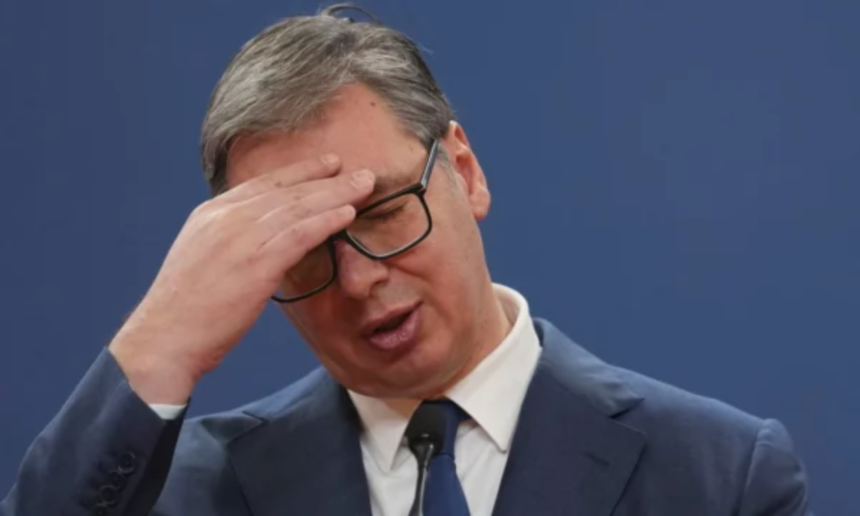
Serbian President Aleksandar Vučić stated on Wednesday that Belgrade had anticipated more decisive steps from the administration of U.S. President Donald Trump, but so far, no significant impact has been felt.
“When we talk about tariffs, when we talk about sanctions on NIS, none of this has served Serbia’s interests. At the same time, in difficult moments, we did not receive support from other major powers, neither from the East nor from the EU,” Vučić said during the opening of the Conference of Ambassadors of the Serbian Ministry of Foreign Affairs in Belgrade.
The United States imposed sanctions on Serbia’s main oil and gas company, NIS, in October due to Russian ownership. Russia has not shown willingness to sell its majority stake in NIS, which would enable the removal of sanctions and help Serbia avoid a gas crisis. Russian President Vladimir Putin recently said Moscow “has ideas” to resolve the NIS situation but provided no details.
Regarding U.S. tariffs on foreign products, implemented by Trump in April 2025, Serbia has been the hardest hit among Western Balkan states. Tariffs on Serbian products currently stand at 37%, two percentage points higher than the tariffs on goods from Bosnia.
“Serbia Remains on the EU Path”
Discussing Serbia’s challenges, Vučić said that any major power could have supported Serbia in its difficult moments, but all had their own reasons for pressure, expecting much from Belgrade while giving little in return.
“We have understood this message well and know that we cannot be alone in the world. Therefore, we remain on the European path, at least as long as I am president and this parliamentary majority exists, but this is a lesson for us,” Vučić said.
In the past four years, Serbia has not opened any new chapters in EU negotiations, which began more than ten years ago. The latest European Council conclusions note that Serbia’s EU path remains a strategic goal, but reforms have slowed, and progress in justice and anti-corruption efforts is minimal.
Accusations Against Regional Military Cooperation
In his address to ambassadors, Vučić accused regional countries of acting against Serbia, questioning their right to military cooperation. He specifically pointed to Albania, Croatia, and Kosovo, claiming they are forming a “military alliance” after signing a joint declaration in March to strengthen cooperation on security challenges, hybrid threats, and other regional risks.
“Why have they expanded these military agreements to Slovenia and tried so hard to involve Bulgaria? It is clear they did this not for press purposes. Even in discussions with NATO and EU officials, everyone just shrugged,” Vučić said.
According to the Stockholm International Peace Research Institute (SIPRI), Serbia was the largest military spender in the Western Balkans in 2024, allocating $2.2 billion to its army, or 2.6% of its GDP.
Vučić also claimed that “Americans are openly arming Albanians in Kosovo, as well as Turkey,” asserting that the goal is to directly threaten Serbia’s territorial integrity and target civilian and security structures.
The most serious recent armed incident in the Western Balkans occurred in September 2023 in northern Kosovo, when armed Serbs attacked the Kosovo Police in Banjskë, killing one officer. Three attackers were also killed. Kosovan politician and businessman Millan Radoiçiq claimed responsibility for the attack and currently resides in Serbia, where he has not faced prosecution. No attacks on Serbian territory by neighboring countries have been reported.
Accusations Regarding Kosovo
Vučić further accused Kosovo and major powers of failing to respect agreements reached under the Brussels Dialogue between Belgrade and Pristina. The last agreement, reached by Vučić and Kosovan Prime Minister Albin Kurti in February 2023, aimed to normalize neighborly relations but has never been implemented.
Contrary to the agreement, under which Serbia would halt its campaign to revoke recognition of Kosovo, Vučić stated that Serbia “will have to continue the difficult and exhausting work of reversing recognitions.”
“For us, Kosovo and Metohija are an inseparable part of Serbia—this has always been so and will remain so. I know it’s uncomfortable to speak about this in London or Washington… but this is the reality, so let’s avoid debates or negotiations on this,” Vučić said.
In 2025, more countries recognized Kosovo. Kenya, Sudan, Syria, and the Bahamas granted recognition this year, bringing the total number of states acknowledging Kosovo to 121.